Friday, November 30, 2007

CXO: (The Worldwide) Futility of Market Timing

The CXO Group has an interesting article based on this paper. I have read arguments about this stuff for years but that is not the topic I want to discuss. CXO highlights the following paragraph:

  • Black swans exist among daily equity returns at a much greater than normal frequency. For example, a $100 passive investment in the Dow Jones Industrial Average at the beginning of 1900 grows to $25,746 by the end 2006 (5.3% mean annual compound return), but:
    • Missing the 10 best days (0.03% of trading days) reduces terminal wealth by 65% to $9,008 (4.3% mean annual compound return). Missing the 20 best days reduces the terminal wealth by 83% to $4,313 (3.6% mean annual compound return). Missing the 100 best days reduces terminal wealth by 99.7% to just $83 (-0.2% mean annual compound return).
    • Avoiding the 10 worst days boosts terminal wealth by 206% to $78,781 (6.4% mean annual compound return). Avoiding the 20 worst days boosts terminal wealth by 532% to $162,588 (7.2% mean annual compound return). Avoiding the 100 worst days boosts terminal wealth by 43,397% to $11,198,734 (11.5% mean annual compound return).
  • On average across all 15 markets over many decades, missing the 10, 20 and 100 best days reduces buy-and-hold terminal wealth by 51%, 71%, and 98%, respectively. Avoiding the 10, 20 and 100 worst days boosts terminal wealth by 150%, 373%, and 26,532%, respectively. (See the chart below for more recent country by country data.)


The authors derive several points from this data but the point I would take is that one must control risk. The asymmetry of percentage returns makes big losses much more damaging than big gains are helpful. A 100 % gain is erased by a 50% fall. A 50% loss requires a 100% gain to recover. Loss control is key. Great market timing traders tend to be very good at controlling big adverse moves. The great buy and hold investor types are usually described as value investors because they focus on a "margin of safety" ( low risk ) before they ever get in. No matter your time frame of investing or trader focus first on not losing your money.

Update: Saw the following news item today:
The Shanghai Composite Index closed down 1.19% Wednesday at 4,803. At current levels the index is up 79.5% Y-T-D but off 21.6% from the life -time high of 6,124.04 posted October 16.
That sounds pretty good for the year and it is. But the 21.6% fall back is 1,300 points while the gain now is about 2,100 points. So the drop from the highs is almost 65% of the remaining gain. A perfect example of the asymmetry of percentage gains and losses.

Update 2: For those interested in a counter argument to the main topic discussed in the CXO post or in the paper they site I suggest Mark Boucher's excellent book "The Hdege Fund Edge" or Nelson Freeburg's Formula Research paper on Boucher's method.

Alea: On the Famed Magazine Cover Indicator


Alea Blog posted the image above and links to this study of magazine covers as contrarian signals. Time to cover short dollar trades. Whoops too late!

Are Cover Stories Effective Contrarian Indicators?

TOM ARNOLD
University of Richmond - E. Claiborne Robins School of Business
JOHN H. EARL
University of Richmond - E. Claiborne Robins School of Business
DAVID S. NORTH
University of Richmond - E. Claiborne Robins School of Business


Abstract:
Headlines from featured stories in Business Week, Fortune, and Forbes were collected for a 20-year period to determine whether positive stories are associated with superior future performance and negative stories are associated with inferior future performance for the featured company. “Superior” and “inferior” were determined in comparison with an index or another company in the same industry and of the same size. Statistical testing implied that positive stories generally indicate the end of superior performance and negative news generally indicates the end of poor performance.

( hat tip: Abnormal Returns )

Ticker Sense Sector performance Charts


Ticker Sense has a post with good sector charts showing over bought over sold conditions by market sector. The chart above is another chart they posted but on the overall market overbought oversold condition. I won't post the whole group of charts because it is important you click through to their site to see them. i appreciate that they make this available for free.

Wednesday, November 28, 2007

Bespoke: Best Growth Plays in the Nasdaq


A list from Bespoke Investment Group who provide a lot of interesting information on their free site and offer a paid premium service too.

Pit Trader Or Buggy Whip Maker?

As a living breathing pit trader I find I am rapidly becoming a dinosaur.
Pit Trading Fading Fast as Nearly 50% of 2007 Futures Market Volumes Now Transacted through Automated Trading Strategies, Rising to 90% by 2010

Steyn: Bold As Brass

Mark Steyn on crime increases in Britain:
Back in the Seventies, it was discovered that the Royal Canadian Mounted Police were illegally burning the barns of Quebec separatists. And the then Prime Minister, Pierre Trudeau, remarked with his customary glibness that if people were upset by the illegal barn-burning perhaps he’d make it legal for the Mounties to burn barns. As George Jonas observed, M. Trudeau had missed the point: barn-burning wasn’t wrong because it was illegal; it was illegal because it was wrong. Once that distinction is lost, civil society becomes all but impossible – because a broadly agreed morality plays a big role in social cohesion. Today in the western world, more and more things are illegal but we’re less and less clear what’s wrong. And everywhere but America, where any metal thief who attempts to steal your doorknob risks staggering away with at least as much metal lodged in his vital organs as in his swag bag, the state doesn’t trust its citizens to defend their property and in doing so uphold what’s right.
Steyn's point is excellent. The caving in to Muslim's who want to live under their own laws even when living in another country, or pandering to illegal immigrants who refuse to try to become a legal participant of this country reflect a breakdown in the broadly agreed morality that makes a free society work. I am very pro immigration, but legal immigration only. People who want to come and enjoy Americas benefits must become Americans. They need not abandon their heritage or deny it but, they must embrace our heritage too.

Tuesday, November 27, 2007

Jim Grant on Benjamin Graham

Follow this link to the text of a speech by Jim Grant on Benjamin Graham, mentor to Warren Buffett and the father of security anlysis.

Sunday, November 25, 2007

This is amazing: an Eighth Wonder of the World

This is an amazing story. There are many pictures.

Eighth wonder of the world? The stunning temples secretly carved out below ground by 'paranormal' eccentric

by HAZEL COURTENEY - More by this author » Last updated at 09:58am on 22nd November 2007

Comments Comments (16)

Nestling in the foothills of the Alps in northern Italy, 30 miles from the ancient city of Turin, lies the valley of Valchiusella. Peppered with medieval villages, the hillside scenery is certainly picturesque.

But it is deep underground, buried into the ancient rock, that the region's greatest wonders are concealed.

Here, 100ft down and hidden from public view, lies an astonishing secret - one that has drawn comparisons with the fabled city of Atlantis and has been dubbed 'the Eighth Wonder of the World' by the Italian government.

BCA: "Fed Falling Behind The Curve"

from the Bank Credit Analyst:
The rioting in the financial markets this month must be reversing this economic complacency. Credit conditions are tighter than they were before the Fed began cutting rates, and strains could be spreading into the prime mortgage market (as previously noted). Bottom Line: The financial markets are warning of real economic damage, which will force the Fed to drop its concerns over inflation and provide a significant amount of additional easing.

Europe Getting Subprime Jitters Round Two

From Mish's Global Economic Trend Analysis this article:
Credit markets have deteriorated badly in both the EU and UK.
Mish links to the following articles:
FT- ECB is set to pump cash into money markets
Telegraph - Worse to come, warns Bank chief

update: Tim Price of The Price Of Everything chimes in.

Minyanville: Liquidty Pump Runs Dry

Mike Shedlock writes a good article on the Minyanville site delineating the breakdown of liquidity in the commercial paper and money markets. He is very astute and writes many very informative posts on the market and especially on the subprime problems. However I disagree with his summary line in this article:
Slashing rates to 1% was what created this mess. Cutting them to 1% again can hardly be the solution.
Abandoning any type lending standards or credit quality controls is what led to this crisis. Loans to borrowers with good credit scores, adequate income coverage, and with 20% down payments for purchase of homes with accurate appraisals are not defaulting at high rates.
The insertion of many layers of intermediaries between borrowers and investors is what led to abandonment of credit standards. Too many performance based money managers chasing extra yield without personal money at risk, too many Wall Streeters chasing fees (including rating agencies) pushing money at mortgage brokers only too happy to earn fees by lending to anyone who walked in the door, and finally too many unsophisticated borrowers watching "flip this house" speculating on homes. Granted low yields made all this possible but, it did not make it necessary. The final buyers of all these securitized mortgages were too distant from the process and removed all incentives for caution leaving only those incentivized by volume.

Saturday, November 24, 2007

Quant funds illustrated


from John Mauldin's Outside the Box newsletter and originally the New Yorker Magazine.

Bespoke: On the advantage of International earnings


This chart from Bespoke Investment Group compares stock performance between S&P stocks with greater than 50% of earnings generated internationally to those with less than 50%. clearly the dollar's weakness benefits those with larger amounts of earnings overseas. A recession in the U.S. would likely increase the advantage if overseas economies stay relatively strong.

Vodkapundit: "don't taser me Bro."

Scary.

Thursday, November 22, 2007

Those Lovable Saudis

Those fun loving Saudi Islamists continue to live down to expectations. From John Mauldin's weekly letter:

I usually avoid controversial matters, other than economics and finance, but I came across a story which I think deserves attention. It seems that a 19 year old young lady in Saudi Arabia was gang-raped by six armed men. They got between one and five years in prison. Because she was in a car with a man who was not related to her, she was given a sentence of 90 lashes. Because she appealed and a higher court ordered another trial, the court then more than doubled the sentence to 200 lashes.

"A court source told the English-language Arab News that the judges had decided to punish the woman further for 'her attempt to aggravate and influence the judiciary through the media.'" Her lawyer had his credentials removed for defending her. This is simply barbaric. It is an affront to any civilized thoughtful person. Where are the protests? Are we to believe that the Saudi royalty condones such acts?

http://www.breitbart.com/article.php?id=071115145104.rykb7bub&show_article=1Ifanyone

Update: The Breitbart link does not seem to be working properly. Powerline has more info and pressure brought by human rights groups has led to some clarification of the court's rulings.


Happy Thanksgiving

I would like to wish everyone a Happy Thanksgiving. Greg Weldon wrote the Thanksgiving post that follows and I am posting it too because I find it expresses my feelings too.

Give Thanks … Everyday

I’m thankful for Mothers and Fathers, who give so much love, so willingly, and ask for so little …
I’m thankful for people who ‘get it’, and understand that love flows from within …
I’m thankful I finally ‘got it’ … with the help of some of those people …
I’m thankful for a soul mate, with whom to share and expand that love …
… you are the inamorato of my life …
I’m thankful for the innocence, the unconditional love, and the playful enthusiasm
of my children … may that never dissipate …
I’m thankful for those courageous enough to risk their very existence,
so that freedom and liberty may reign …
I’m thankful for America, and what it stands for …
I’m thankful for the warm heart and bountiful hearth of family … on holidays and on any day …
I’m thankful for sparkling blue oceans, above which the radiant sun can rise with a brilliance that
defies rational explanation …
I’m thankful for the waves … the ebb and flow captivates and harmonizes, bridging left brain
sensibilities with right-brain creativity …
I’m thankful for sultry sunsets, and the soulful sense of peace that they exude ...
I’m thankful for the trees rustling, the wind caressing, the squirrels scurrying, and the birds singing …
simple miracles of life …
’m thankful for the moon and stars … the celestial intrigue and endless mystery, reminding us to
remain humble …
I’m thankful for this time here, to enjoy ALL the things I have to be thankful for … and, thankful to
have been able to share these thoughts.

__ Greg Weldon--

seconded by Bruce Lawrence

Tuesday, November 20, 2007

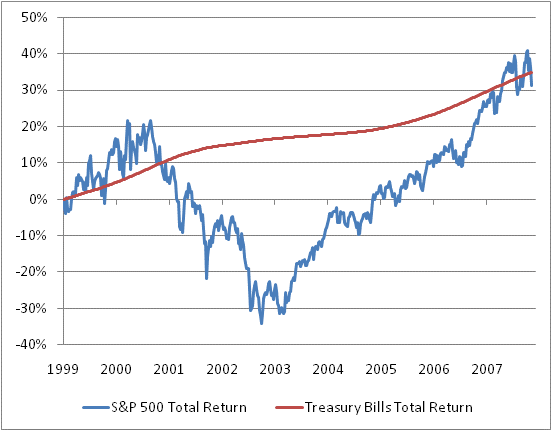
T-bills or the S&P 500, not what you'd expect.


From John Hussman:

The S&P 500 has now underperformed Treasury bills for nearly 9 years. This is a reminder that while valuations may not have much impact on short-term returns, even for several years at a time, they are a powerful and reliable determinant of long-term investment returns.

Hester: Global Yield Curve Leads Global Earnings


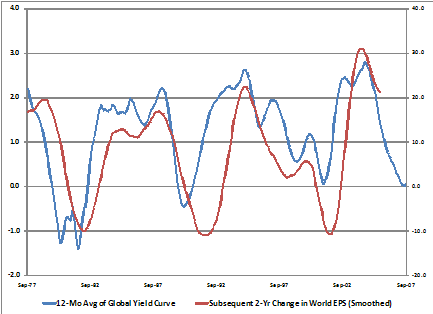
A very interesting article by William Hester includes this chart and discussion:

Changes in World EPS have tracked the shape of the global yield curve closely, usually with about a two-year lag. The global yield curve was inverted from 1979 until 1982. The smoothed World EPS eventually declined by 10 percent. The global yield curve inverted again in 1990, and World EPS declined by a similar amount. In 2001 when the smoothed yield curve flattened, but didn't invert, World EPS again declined by more than 10 percent. The 12-month moving average of the yield curve spread hit zero in July. It has since ticked up a fraction, as short rates have fallen in response to the world-wide credit crisis.

Much like the pattern in U.S. data, year-over-year changes in World EPS have very little correlation with the short-term returns of the MSCI World price index. But the current flatness of the global yield curve may turn out to be important. That's because more extended declines in World earnings have correlated with important declines in MSCI's World price index.

As the chart above shows there have been three meaningful declines in smoothed World earnings, bottoming in 1982, 1991, and 2001. Using monthly data, the smoothed Global Yield Curve bottomed in November 1981, May 1990, and April 2001. The corresponding declines in the MSCI World price index from those points were -17.3 percent, -19.4 percent, -35.0 percent, respectively (the peak-to-trough market losses were even worse).

Monday, November 19, 2007

Calculated Risk: On the Goldman Sachs converence Call

Calculated Risk covers the Goldman Sachs conference call. Below are some of the comments about the mortgage crisis and home prices.

We believe ... the industry will suffer $148 Billion total losses related to CDOs, to date we've accounted for roughly about $40 billion of those, so we're estimating another $108 billion in writedowns over the next several quarters.
Goldman Sachs, Nov 19, 2007
and
House prices have 13% to 14% to fall from current level.
Goldman Sachs, Nov 19, 2007

they went on to say eight states are expected to have price drops of 30%.

A must watch discussion of Subprime

This is an absolute terrific send up of the subprime mess from two British Comics. Brilliant.

Hussman: Critical Point

John Hussman very good again this week:
He repeats a wrning that the Fed is not pumping out as much money as the financial press seems to think
Despite hopes that the Fed can reverse these pressures, the fact is that the entire amount of "liquidity” added to the banking system by the Fed in the past four months amounts to about $15 billion (in a banking system with a thousand times that in loans and assets). On Thursday, several news stories reported that the Fed “pumped $47.25 billion of liquidity into the banking system,” the highest total since September 2001 - but you'll find once again that $40.5 billion of that was pure rollovers of existing repos (which Thomson Financial noted in a news story the day before as my ballpark expectation). The rest is pre-holiday liquidity to accommodate demand for cash. Investors are deluding themselves when they count each rollover of a 3-day, 7-day or 14-day repo as new money. It's the same stuff, rolled over to retire the maturing stuff. The amount of outstanding repos is currently only about $15 billion more than its lowest 30-day average over the past year.
The article covers many topics and I urge investors to read it entirely.

Sunday, November 18, 2007

Bespoke: Another Measure Of Breadth


From the Bespoke Investment Group site:

Upside Volume: Another Measure of Breadth

Buffett and Berkshire

A study of Warren Buffett and Berkshire Hathaway's investment results.
Imitation is the Sincerest Form of Flattery: Warren Buffett and Berkshire Hathaway
a paper by Gerald S. Martin and John Puthenpurackal.
Abstract:
We analyze the performance of Berkshire Hathaway's equity portfolio and explore potential explanations for its superior performance. Contrary to popular belief we show Berkshire's investment style is best characterized as a large-cap growth. We examine whether Berkshire's investment performance is due to luck and find that beating the market in 28 out of 31 years places it in the 99.99 percentile; however, incorporating the magnitude by which Berkshire beats the market makes the “luck” explanation unlikely even after taking into account ex-post selection bias. After adjusting for risk we find that Berkshire's performance cannot be explained by assuming high risk. From 1976 to 2006 Berkshire's stock portfolio beats the S&P 500 Index by 14.65%, the value-weighted index of all stocks by 10.91%, and the Fama and French characteristic portfolio by 8.56% per year. The market also appears to under-react to the news of a Berkshire stock investment since a hypothetical portfolio that mimics Berkshire's investments created the month after they are publicly disclosed earns positive abnormal returns of 14.26% per year. Overall, the Berkshire Hathaway triumvirates of Warren Buffett, Charles Munger, and Lou Simpson posses' investment skill consistent with a number of recent papers that argue investment skill is more prevalent than earlier papers suggest.
The style has to be large cap these days because the amount of money Buffett is managing is so large that investment in small companies would not have a meaningful impact. When investing in smaller companies he buys them entirely.

Guns as a Civilizing Influence

Marko the Munchkin Wrangler writing eloquently in favor of the right to bear arms:

Human beings only have two ways to deal with one another: reason and force. If you want me to do something for you, you have a choice of either convincing me via argument, or force me to do your bidding under threat of force. Every human interaction falls into one of those two categories, without exception. Reason or force, that's it.
and

There are plenty of people who consider the gun as the source of bad force equations. These are the people who think that we'd be more civilized if all guns were removed from society, because a firearm makes it easier for a mugger to do his job. That, of course, is only true if the mugger's potential victims are mostly disarmed either by choice or by legislative fiat--it has no validity when most of a mugger's potential marks are armed. People who argue for the banning of arms ask for automatic rule by the young, the strong, and the many, and that's the exact opposite of a civilized society. A mugger, even an armed one, can only make a successful living in a society where the state has granted him a force monopoly.
Hat tip to The Instapundit (Again, when does Glenn sleep?)

Steyn: The World Should Give Thanks For America

Mark Steyn produces an excellent Thanksgiving piece.

But on this Thanksgiving the rest of the world ought to give thanks to American national sovereignty, too. When something terrible and destructive happens – a tsunami hits Indonesia, an earthquake devastates Pakistan – the United States can project itself anywhere on the planet within hours and start saving lives, setting up hospitals and restoring the water supply.

Aside from Britain and France, the Europeans cannot project power in any meaningful way anywhere. When they sign on to an enterprise they claim to believe in – shoring up Afghanistan's fledgling post-Taliban democracy – most of them send token forces under constrained rules of engagement that prevent them doing anything more than manning the photocopier back at the base.

If America were to follow the Europeans and maintain only shriveled attenuated residual military capacity, the world would very quickly be nastier and bloodier, and far more unstable. It's not just Americans and Iraqis and Afghans who owe a debt of thanks to the U.S. soldier but all the Europeans grown plump and prosperous in a globalized economy guaranteed by the most benign hegemon in history.

Hat Tip (as usual) to The Instapundit

Saturday, November 17, 2007

BCA:U.S. Inflation …. Or Deflation?


The Bank Credit Analyst has a post titled U.S. Inflation …. Or Deflation? I have noted several times the evidence of rising inflation fears in the price rise of gold or crude oil or grains or the falling dollar. Jeff Matthews has also recently had posts about inflationary tendencies in An inflationary spiral coming out of China”.
So the BCA's comments that deflationary risks are rising and inflation risks diminishing is contrary to my recent bias and worth noting. Ignoring contrary evidence can be a very expensive habit in the trading business.

Friday, November 16, 2007

Thursday, November 15, 2007

More Disturbing Behavior By Congress

Congress stoops to new lows by trying to prevent any any access to details in appropriations so they can dole out payoffs without scrutiny.
Rollcall:
Michael Goldfarb:
It's stunning that Congressional leaders would propose a new law to block Congress and the public from simply reviewing the details of the federal budget. The Appropriations Committee rewrites the president's proposed budget as a matter of course, but now they are attempting to head off questions about their spending decision by ensuring that only appropriators know the details of the president's proposal. The arrogance of the move is mind-blowing.
Glenn Reynolds:
PUTTING AN END TO BUDGET TRANSPARENCY? We need much more transparency, not less. This is shameful.
I repeat myself but here goes: Throw the bums out. Vote against all incumbents of both parties. Pajamas Media needs to get that freerangers section going again.

Never Forget and Keep Your Eyes Peeled

I watched a dull situation comedy show tonight whose partial theme was derision of homeland security and the program encouraging citizens to report suspicious behavior. Typical Hollywood leftist denial of the plain and demonstrable fact that there are people out there who wish to do us harm.
So I wanted to point out this article as a reminder we are at war with terrorists.

Criticisms of post-9/11 efforts to protect the United States from attack range from claims that America is more vulnerable than ever to the contention that the transnational terrorist danger is vastly over-hyped.[1] A review of publicly available information on at least 19 terrorist conspiracies thwarted by U.S. law enforce­ment suggests that the truth lies somewhere in between these two arguments.

U.S. agencies are actively combating individuals and groups that are intent on killing Americans and plot­ting mayhem to foster violent extremist political and religious agendas. A review of the data suggests several important conclusions:

  • Combating terrorism is essential for keeping Amer­ica safe, free, and prosperous.

  • Counterterrorism operations have uncovered threats that in some cases, although less sophisticated than the 9/11 attacks and at most loosely affiliated with "al-Qaeda" central, could have resulted in signifi­cant loss of life and property if they had been con­ducted successfully.

  • The best means to prevent terrorist attacks is effective intelligence collection, information sharing, and coordinated, determined counterterrorism opera­tions that can stop attacks before they are mounted.

  • Effective operations often require federal, state, local, and international cooperation.

Few of the planned attacks were potentially as dev­astating in scope as the September 11, 2001, attacks on Washington and New York. In addition, the suc­cessful interdiction of these efforts offers no guaran­tee that future attacks will also be prevented.


Thatcher Or Hillary; No Contest!

Peggy Noonan nails one in the Wall Street Journal:
Margaret Thatcher would no more have identified herself as a woman, or claimed special pleading that she was a mere frail girl, or asked you to sympathize with her because of her sex, than she would have called up the Kremlin and asked how quickly she could surrender.
Read the whole thing.

Subprime The Energizer Bunny of Problems

The hits just keep on coming in the subprime news. This Bloomberg article:
U.S. Stocks Decline; Wells Fargo, Fannie Mae, J.C. Penney Drop
contains the following paragraph:
The S&P 500 Financials Index of 93 companies also dropped after Deutsche Bank AG, Germany's biggest bank, lost an effort to foreclose on 14 properties because a federal judge in Cleveland found the bank hadn't proved that investors in the underlying mortgages actually owned them. The ruling, if adopted by other federal courts, may complicate efforts by investors in mortgage securities to foreclose on non-paying loans.
The tricky slicing and dicing of mortgages that goes on in modern asset backed finance definitely clouds the issue of who actually owns the mortages and can therefore foreclose on those that don't perform. I do not have legal training but this smells like a real tarbaby for the justice system and the institutions holding this paper.

Subprime Spooking The Market Again

From Bloomberg:

Nov. 15 (Bloomberg) -- The crisis of confidence in bond insurers that bestow top credit ratings on debt sold by borrowers from the New York Yankees to Citigroup Inc. may cost investors as much as $200 billion.

The AAA ratings of MBIA Inc., Ambac Financial Group Inc. and their five smaller competitors are being reviewed by Moody's Investors Service and Fitch Ratings. Without guarantees, $2.4 trillion of bonds may fall in value and some issuers would get shut out of the capital markets.

``We shudder to think of the ramifications,'' said Greg Peters, head of credit strategy at New York-based Morgan Stanley, the second-biggest U.S. securities firm by market value. ``You have politicians, taxpayers, municipalities, states. It just opens up a Pandora's box. That is a huge destabilizing force.''

Tuesday, November 13, 2007

Hussman: Expecting Recession

John Hussman's weekly piece is especially good this week.
Some excerpts:
On Saturday, the consensus of economists surveyed by Blue Chip Economic Indicators indicated expectations that growth will be sluggish into next year, but that there will be no recession. Unfortunately, the economic consensus has never accurately anticipated a recession. For my part, the outlook has changed. I expect that a U.S. economic recession is immediately ahead.
and
One way to understand this change in outlook is to examine our 4-indicator “rule of thumb” – a simple composite of readily obtainable indicators that have been observed in every U.S. recession. It is a syndrome of conditions that are logically and historically related to economic weakness, none particularly informative when observed individually, but important when they occur together. They are: widening credit spreads, a moderate or flat yield curve, falling stock prices, and a weak ISM Purchasing Managers Index. Notice that we are not interested in the behavior of any single indicator, but rather in a group of indicators that collectively indicate deteriorating growth expectations and rising credit risks.
and this very insightful comment on investment regret ( or buyer's remorse ):
Anytime you discover you are taking too much risk, realize in advance that you will experience some level of regret as you correct it – if you sell your first portion and the market advances, you'll regret having sold anything. If you sell your first portion and the market continues to decline, you'll regret that you didn't sell everything. The way to keep from being “paralyzed” in the financial markets is to realize in advance that gradually changing an investment position will always involve regret. It is better to “lock in” an acceptable level of regret than to risk an unacceptable loss.
I own some of each of the Hussman Funds because of his well developed approach to risk control. I also read his weekly remarks faithfully, because he consistently teaches me new things.

Monday, November 12, 2007

Instapundit: "Remember, it's not just the waste. It's the corruption."

The Instapundit points to this article on one more corrupt congressman, Alaska's porkmeister Rep. Alan Young.

Earmarks, favors: Young used position for funds and his donors' projects

Time after time in recent years, Young approved millions of dollars for highway projects for people who in turn fattened his campaign treasury.
This guy is a Republican but it hardly matters. Both parties are filled bloviating sellouts willing to be bought for a few thousand. Throw all the bums out! Vote against all incumbents.

Gore's Fellow Nobel Winners Issue A Report

The Goracle better hurry up and get the dmocratic party to draft him as their candidate because his credibility looks to be short lived.
From the Telegraph:
This week, the United Nations' climate scientists will release a major report synthesising the world's best global warming research. It will be the first time we've heard from the Intergovernmental Panel on Climate Change (IPCC) since its scientists won the Nobel Peace Prize with former US vice-president Al Gore.
in this report :
While Gore was creating alarm with his belief that a 20-foot-high wall of water would inundate low-lying cities, the IPCC showed us we should realistically prepare for a rise of one foot or so by the end of the century. Beyond the dramatic difference, it is also worth putting that one foot in perspective. Over the last 150 years, sea levels rose about one foot - yet, did we notice?

Saturday, November 10, 2007

Jennifer Cavan Studios


Highly Recommended. ( disclosure: Paintings by my very talented sister-in-law.)

BCA: CDO Losses Mount

From the Bank Credit Analyst:
The combination of high leverage and sharp price declines has ripped through the investment banks, according to the latest round of earnings reports. Yet more pain could lie ahead. Home prices still have much further to fall, which ensures that this will not be the last round of downgrades.

Friday, November 9, 2007

Of Course The Republicans Aren't Any Better

WASHINGTON — Sen. Joe Lieberman on Thursday painted a dim picture of his party, saying Democrats have given up their moral authority on foreign policy because they are more concerned with opposing Republicans than doing what is right.

Hat Tip Instapundit

Throw all the bums out of office.


Congress Helping London Become The World Finance Leader

The sticky fingered and self important group of windbags we call Congress has taken another important step in making London the financial center of the world instead of New York.
House Passes Tax Rise on Hedge-Fund, Buyout Managers

Level 3 is going to be the new buzzword

If you haven't already be prepared to hear a lot of talk about Level 3 assets.
Banks Face $100 Billion of Writedowns on Level 3 Rule
Nov. 7 (Bloomberg) -- U.S. banks and brokers face as much as $100 billion of writedowns because of Level 3 accounting rules, in addition to the losses caused by the subprime credit slump, according to Royal Bank of Scotland Group Plc.
John Glover of Bloomberg has written several very good articles on this. This is a very big deal and is responsible for the sell of in the US stock market this week.

A related article at Bloomberg:
U.S. Three-Month Bill Yields Tumble as Subprime Concern Rises

Thursday, November 8, 2007

Fun With Stocks

The stock market players out there should take a look at Marketocracy.
This is a fun site where for free one can set up a run a mutual fund on paper. All the work is done by the site, including monitoring adherence to the covenants of the fund. The idea is to identify people who have investment talent.
I have used it for years as a way to keep up with stocks I am interested in and to play with decision making rules. I am not very active with it anymore but, once a quarter or so I check in a adjust my portfolio. I have over the 5 plus year period outperformed the S&P by about 9% a year with around half the volatility spending literally almost no time on the process. Here is the method I used. I picked value stocks or strong themes like resources. I never put more than about 3% in a single stock and if the stock lost 10% I sold it. If a stock grewo to be more than 5% I trimmed it back to around 3%. That is the whole process and it did way better than my real accounts with significantly simpler procedures.

Monday, November 5, 2007

Commercial Real Estate Slowdown On The Horizon?


Calculated Risk has this chart and a short post about signs of a slowdown in the the commercial real estate markets.
Loan demand (and changes in lending standards) lead CRE investment for an obvious reason - loans taken out today are the CRE investment in the future. This report from the Fed suggests a slowdown in CRE investment in the near future.

Commercial Real

Commercial Real

Accrued Interest Explains CDO Risks Simply

Very nice explanation of riskiness of CDO with subprime mortgage paper at Accrued Interest

Looking for a New Political Party.

Stephen Bainbridge sounds like he is looking for a new party:

Is the Supreme Court Why I’m a Republican? Or Used to be?


Vote against all incumbents. That is my plan.

Sunday, November 4, 2007

Karl Rove: "corruption, not Iraq, will be the No. 1 issue.”

More evidence for the throwing the bums out campaign:
Patterico discussing Rove's remarks and linking to three Instapundit posts on corrruption, pork, and earmarks.

Vote against all incumbents of both political parties in the coming national elections. We have no hope of dealing intelligently with problems like Iraq, Islamic terrorism, social security and medicare deficits, or healthcare when the political process is controlled by pigs at the trough.

Murtha seems to be the posterboy for curruption and greed, read this infuriating article:

A Contractor, Charity And Magnet for Federal Earmarks

Behind the rise of Concurrent is Rep. John P. Murtha (D-Pa.), chairman of the House Appropriations Committee's defense subcommittee, who helped arrange funding to launch the organization in 1988. Murtha has since arranged millions of dollars more in directed congressional appropriations called earmarks. Now Concurrent has nearly $250 million in annual revenue and 1,500 employees.

Saturday, November 3, 2007

BCA: The Fed Has More To Do

BCA: Explaining The Stampede Into China And India


A Bank Credit Analyst article and chart illustrating the same point David Fuller was making when I quoted him in Go East Young Man.

Thursday, November 1, 2007

Inflation Adjusted Charts


Commodities: They Aren't Just For Gamblers Anymore

This article appeared in the Sunday Times: Boom That Could Last A Hundred Years

That China could attract foreign capital and export freely has meant that a nation that was in the dark ages for 60 years was suddenly accepted as a trading partner, and that opened up huge possibilities.

But hasn’t the sector got too hot in the short term?

I don’t believe in the short term; I think it’s the wrong way to invest. We have suddenly multiplied the consuming population by four or five times by having this open world. This process won’t play out for 100 years or maybe 150 years.

Booming commodity prices caused by booming demand is always accompanied by volatility. Take a look at charts from the 70's in grains for an example. But volatility can be your friend if you plan for it. Ben Graham described the market as a manic depressive, one day paying too much and the next selling too low. Commodity markets are even more like that.