Roger’s Rules » When “acknowledgment” means “perpetuation,” or Obama, liberals, and the issue of race.
A very good article click through.
A very good article click through.
July 30 (Bloomberg) -- Baxter International Inc.'s drug for immune system disorders also shows promise for treating Alzheimer's disease, a small company-funded study found.
Baxter's Gammagard boosts the body's natural defenses with antibodies extracted from human blood. It's now given to patients who don't make their own version of the immune system cells needed to prevent infections. Early research suggests it may attack certain proteins, called beta amyloid, that cluster around nerve cells in the brains of Alzheimer's patients.
In a study of 24 patients, those who received injections of the drug did better than those first given a placebo on tests of mental and physical function. The benefit increased with time, with Gammagard patients scoring 5.4 points higher than placebo patients on a 7-point scale of cognitive ability after nine months, the researchers said. Some of the very first patients to test the therapy are doing well years later, researchers said.
``We have patients now four and five years out who are still where they were when they started'' using Gammagard for Alzheimer's, Norman Relkin, a neurologist who in April reported positive findings for patients after six months, said in a telephone interview. ``Compared with what we can do now with available drugs, that's quite remarkable.''
REITERATING AN IMPORTANT
THEME: Friday we took the time to write about the
recent "discovery" of huge new deposits of crude and
natural gas by the US Geological Survey team in the
Arctic. We spoke at some length about what the USGS
had found, and we took the Left to task for its improper
understanding of what had been found. The response to
this comment on our part was perhaps the strongest we'd
gotten on anything we'd written in a very long while, so
we thought we'd repeat a portion of it again here this
morning so that our clients in the US might take the time
to send a note to their Congressman (or woman, as the
case may be) and to their Senators to show them the
fallacy the Left is beholden to regarding oil exploration
and discovery.
The problem, as we said Friday, is that the Left is
misleading the public on what the USGS found and no
one from the energy industry or from government or from
the free market is taking the Left's spin to task. The Left
said that the 90 billion barrels of crude it believes exist in
the Arctic will amount to only three years of demand and
that this is too little to put the Arctic at risk. The Left
arrived at this 3 year figure by taking the 90 billion barrels
of crude and dividing it by 86 million barrels, which is the
amount of crude oil used globally on a daily basis. That
is indeed 1046 days worth of crude oil at today's usage
rate; however, what the Left conveniently has forgotten to
tell anyone is that they've not taken into consideration the
fact that the world is using 86 million barrels of crude
each day and it has them to use! These current supplies
are not going to suddenly cease to exist; they will
continue on for years into the future, and even the "Peak
Oil" theorists shall not argue that fact. Thus, the 90
billion in undiscovered crude would be new supplies
added at the margin. If the world might increase its use
by an additional 2 million barrels/day, it would take 123
more years to use up this new crude oil! No one on the
Left would ever make that case, for the public would say,
collectively, "What the heck are we waitin' for? How come
we are not drillin' right now; right this very afternoon, to
find this crude up there in the cold, cold north, populated
only by an increasing number of polar bears and elk?"
The NY Times, the LA Times, The Washington Post, all
represented the new crude oil in the "only three years
worth of crude" manner. No one, other than TGL, is
presenting it in the proper 123 years manner. Further, the
Left will argue that drilling in the Arctic shall be
ecologically damaging, citing the Exxon Valdez accident
of two decades ago as evidence. This is nonsense for the
simple reason that since then single hull tankers are
illegal. What might have been an accident two decades
ago is nearly an impossibility now.
Further, the Left argues that drilling is itself fraught with
disaster, but if we are to learn anything from the
aftermath of Hurricane's Katrina and Rita of two years
ago it is this: these "once-in-a-century" weather
problems resulted in not one leak from any well drilled in
the Gulf of Mexico! Not one! Not one barrel of crude
leaked out; not but a very, very few cubic feet of natural
gas escaped. The oil companies and the drillers have
advanced their activities to a level simply not understood
by the eco-radicals and those on the Left. This needs to
be passed on, so pass it on
Finally, we note that the USGS reports energy
discoveries using what it calls "undiscovered technically
recoverable resources" in this report. By that the USGS
means crude and nat-gas that can likely be produced
using only "current technology." That then is another
important point, for we know of one thing upon which we
can count in the modern world: technology continues to
push the energy business. What is currently possible was
not ten years ago, and what is currently possible now will
look comical and unsophisticated ten year hence. If
there is 90 billion of undiscovered crude beneath the
Arctic using current technology, then it is reasonable to
believe that there will be a good deal more than that
using future technology.
There are few things in the world of energy one can rely
upon, but one can rely upon the fact that technology
expands supplies more swiftly than we can use them. As
we are wont to say "We did not leave the Stone Age
because we ran out of stone." We left the Stone Age
because new technologies ended it for our ancestors,
just as we shall end the present carbon fuel era for our
children and their children and their children's children by
pushing for technological change. This is the real change
we can count up, to steal Sen. Obama's tag line.
Tuesday, July 29, 2008 Tel: 757 238 9346
Fax: 757 238 9546
E-mail: dennis@thegartmanletter.com
London Sales Office: Donald Berman, Alberdon Int'l. London
Fax 442076286811
Phone 447986221110
July 26 (Bloomberg) -- U.S. banking regulators closed two
lenders in California and Nevada, two weeks after the collapse
of IndyMac Bancorp Inc., as loan defaults and foreclosures soar.First National Bank of Nevada, with $3.4 billion in assets,
and Newport Beach, California-based First Heritage Bank, with
$254 million, lacked sufficient capital, the Office of the
Comptroller of the Currency said yesterday in a statement. Their
deposits and some assets will be acquired by Mutual of Omaha
Bank, the Federal Deposit Insurance Corp. said.
LAT Gags Blogs: In a move that has apparently stirred up some internal discontent, the Los Angeles Times has banned its bloggers, including political bloggers, from mentioning the Edwards/Rielle Hunter story. Even bloggers who want to mention the story in order to make a skeptical we-don't-trust-the-Enquirer point are forbidden from doing so. Kausfiles has obtained a copy of the email Times bloggers received from editor Tony Pierce. [I've excised the recipient list and omitted Pierce's email address]:
From: "Pierce, Tony"
Date: July 24, 2008 10:54:41 AM PDT
To: [XXX]
Subject: john edwards
Hey bloggers,
There
has been a little buzz surrounding John Edwards and his alleged affair.
Because the only source has been the National Enquirer we have decided
not to cover the rumors or salacious speculations. So I am asking you
all not to blog about this topic until further notified.If you have any questions or are ever in need of story ideas that would best fit your blog, please don't hesitate to ask
Keep rockin,
Tony
That will certainly calm paranoia about the Mainstream Media (MSM) suppressing the Edwards scandal. ...
P.S.: Is the Times' edict a) part of a double-standard that favors Democrats (and disfavors Republicans like Rep. Vito Fossella and John McCain)? Or does it b) simply reflect an outmoded Gatekeeper Model of journalism in which not informing
readers of certain sensitive allegations is as important as informing
them--as if readers are too simple-minded to weigh charges that are not
proven, as if they aren't going to find out about such controversies
anyway? I'd say it's a mixture of both (a) and (b). This was a sensational scandal the LAT and other MSM papers passionately did not want to uncover when Edwards was a formal candidate, and now that the Enquirer seems to have done the job for them it looks like they want everyone to shut up while they fail to uncover it again. ...
P.P.S.: The Times apparently failed to get word of the ban to one of its bloggers in time to prevent her from shocking readers by saying she hoped the allegations against Edwards weren't true. ... 2:55 A.M. link

Washington Mutual debt protection costs jumpThe second article is here and continues the discussion from the first article.
Action in Credit Default Swaps (CDS) show a large as well as increasing chance of bankruptcy at WaMu. Reuters is reporting Washington Mutual debt protection costs jump .Credit protection costs on Washington Mutual rose sharply on Friday, a day after an analyst said some creditors reduced their exposure to the largest U.S. savings and loan.Not Just WaMu
The cost of protecting [$10 million of] Washington Mutual's debt for five years rose to $1.85 million on an upfront basis, plus $500,000 in annual premiums, up from about $1.35 million plus $500,000 annually on Thursday, according to a trader.
By the way, I am not just talking about WaMu here. Any bank whose share price is in the single digits is at extreme risk. Any bank whose share price is under $5 is at risk of imploding overnight.
This is good news and overlooked in election year rhetoric.In the midst of the current widespread gloom and doom in the west,
it is important not to lose sight of the true structural themes shaping
our era.Linked to the current mood, commentators often depict
an embattled and shrinking middle class, with sharply rising financial
inequality. However, globally, this is simply not true. One of the most
startlingly positive phenomena for many generations continues to unfold
around the world. We are in the middle of an explosion of the world’s
middle class.As two of my colleagues, Dominic Wilson and Raluca
Dragusanu, showed in a paper Goldman Sachs published last week (The
Expanding Middle: The Exploding World Middle Class and Falling Global
Inequality), about 70m people a year globally are entering this wealth
group, as defined by those on incomes of between $6,000 and $30,000
(€3,800-€19,000, £3,900-£15,000), in purchasing power parity terms.The
phenomenon may continue for the next 20 years, with this global middle
accelerating to 90m a year by 2030. If this happens, an astonishing 2bn
people will have joined the ranks of the middle class. This
demonstrates that, contrary to widespread opinion, global inequality is
declining significantly, not increasing.
Please consider Bond Sales Slow to $5.3 Billion as Spreads Approach March HighsCorporate
bond sales fell to $5.3 billion this week as the yield over benchmark
rates that investors demand to own the debt approached the highest
levels of the year. Sales compare with $11.7 billion last week,
according to data compiled by Bloomberg.
Issuance slowed as the
average spread on investment-grade bonds climbed to 7 basis points shy
of its 2008 high and junk- bond spreads surpassed 800 basis points for
the first time since March.
Overall corporate sales compare with a weekly average this year of $21.2 billion.
The
extra yield investors demand to own investment-grade bonds rather than
U.S. Treasuries climbed 9 basis points to 297 basis points as of
yesterday, compared with 305 basis points reached on March 20,
according to Merrill Lynch & Co.'s U.S. Corporate Master index.
We suspect the latter will begin in 2009, as the domestic economy slows sharply and the U.S. begins to recover.
The American
Physical Society, an organization representing nearly 50,000
physicists, has reversed its stance on climate change and is now
proclaiming that many of its members disbelieve in human-induced global
warming. The APS is also sponsoring public debate on the validity of
global warming science. The leadership of the society had previously
called the evidence for global warming "incontrovertible."In a posting
to the APS forum, editor Jeffrey Marque explains,"There is a
considerable presence within the scientific community of people who do
not agree with the IPCC conclusion that anthropogenic CO2 emissions are
very probably likely to be primarily responsible for global warming
that has occurred since the Industrial Revolution."
The APS is opening its debate with the publication of a paper
by Lord Monckton of Brenchley, which concludes that climate sensitivity
-- the rate of temperature change a given amount of greenhouse gas will
cause -- has been grossly overstated by IPCC modeling. A low
sensitivity implies additional atmospheric CO2 will have little effect
on global climate.Larry Gould, Professor of Physics at the University of Hartford and
Chairman of the New England Section of the APS, called Monckton's paper
an "expose of the IPCC that details numerous exaggerations and
"extensive errors"In an email to DailyTech, Monckton says, "I was dismayed to
discover that the IPCC's 2001 and 2007 reports did not devote chapters
to the central 'climate sensitivity' question, and did not explain in
proper, systematic detail the methods by which they evaluated it. When
I began to investigate, it seemed that the IPCC was deliberately
concealing and obscuring its method."
It’s the fastest in the world in a month, & twice Chinese outflows
MUMBAI: The speed at which they are fleeing, investors in Indian
markets could give sprinters at the Beijing Olympics a run for their,
er, medals.India-dedicated funds have seen $944 million outflows
in the month to July 9, the highest redemption faced by any
country-specific funds group in the period, according to EPFR Global
data.According to EPFR Global, billions of dollars of outflows from
offshore Asian funds have been going on for five weeks in a row and
reached $1.8b in the week ended July
9.Comparing this with the
size of weekly redemptions between mid-December and late February, the
average outflow of $1.5 billion in the last five weeks is 48% bigger.
Citigroup
Asia Pacific analysts Elaine Chu, Markus Rosgen and Brian Li said with
Asian stocks underperforming world equities by 955 basis points year to
date, net outflows from Asian funds have risen to $13.2 billion so far
this year.“Alternatively speaking, 80% of new money taken in last year is now redeemed,” they said in a strategy note on Monday.


Opening up the North Sea in the 1970s helped break the power of Opec, the oil producers’ cartel, and deliver two decades of cheap energy, from the mid-1980s to the mid-2000s. Now, the region is one of the fastest-declining oil provinces in the world, according to the International Energy Agency. On the UK side, oil and gas output peaked at the turn of the decade and has been falling by 7.5 per cent a year since 2002.
Today, the North Sea supplies about 4m barrels of oil a day from the UK and Norway, meeting about 4.7 per cent of global demand. That is about as much as Iran and more than Kuwait, Venezuela or Nigeria. By 2013, that will have dropped to 3m b/d or 3.2 per cent of demand, the IEA predicts.
The article continues providing a lot of interesting observations. Myopic politicians would do well to read this short article about the negative implications of North Sea oil production declines and the benefits that accrued to Britain and Norway from the opening of the North Sea production.
Novartis will pay more than SFr900m ($874m, €556m) for Speedel,
a small Swiss biotechnology group, to secure full control of a new
blood pressure drug – a potential blockbuster – and a pipeline of
associated products.
...
That would give Novartis a 61.4 per cent stake in Speedel, prompting a
mandatory public offer at the same price. The offer price is almost
double Speedel’s SFr64.10 closing price on Wednesday and an 80 per cent
premium to its volume-weighted average price over the past 60 days.
Go to Bespoke to see the sector charts.Percentage of Stocks Above 50-Day Moving Averages
Currently, just 14% of stocks in the S&P 500 are trading above their 50-day moving averages. While this is extremely oversold, the number got down to 8% last August and 11% in January.
Financials and Industrials are the sectors struggling the most. Each of them have just 2% of stocks trading above their 50-days. Consumer Discretionary isn't far behind at 5%, however. The two sectors that look the best at the moment are Health Care and Utilities. Health Care has 42% above their 50-days, while the Utilities sector sits at 39%.
CHINESE export growth has slowed to its lowest rate in at least five years, raising new risks for the world economy.China's export volumes grew just 7 per cent in the year to June -
down from sustained growth rates above 20 per cent before the middle of
last year - and they are likely to fall further as key markets in the
United States and Europe continue to deteriorate."It's signalling that by the end of the year we'll have zero export
growth," said Stephen Green, an economist with Standard Chartered Bank
in Shanghai.hat tip to Fullermoney
Do you think $140 a barrel is insane? Last week the president of
OPEC Chakib Khelil predicted $170 a barrel by summer’s end. More
sobering, this week the U.S. Energy Information Administration forecast
world energy use to grow fifty percent by 2030.If that pans out, it would mean the world will need to burn more
than 120 million barrels of oil that day. We have it, but can we afford
it? Nope, and that is why the oil domain is crumbling.
Investment Postcards From the Edge
“The financial crisis has shown that markets are bubble-prone and that laissez-faire regulation doesn’t work. The authorities need to get a grip if we are to avoid a mega-bubble. But we may need an even deeper crisis for that to happen.” That is the conclusion of a fascinating round-table discussion just published by Prospect magazine.
The participants (from top left to bottom right) were: Mark Hannam who spent 12 years working in the City for the Bank of England, Citibank and Barclays; Jonathan Ford (chair), deputy editor of Prospect; John Gieve, deputy governor for financial stability of the Bank of England; Martin Wolf, chief economics commentator at the Financial Times; Anatole Kaletsky, an economic commentator and associate editor of the Times; and George Soros, chairman of Soros Fund Management.
click here for full text of this interesting article.
andBAGHDAD – How are you spending your 4th of July holiday? While most Americans probably slept, 1,215 Soldiers, Sailors, Airmen, and Marines raised their right hands and committed to a combined 5,500 years of additional service during the largest reenlistment ceremony in the history of the American military. Beneath a large American flag which dwarfed even the enormous chandelier that Saddam Hussein had built for the Al Faw Palace, members of all services, representing all 50 states took the oath administered by Gen. David Petraeus, Commander of Multi-National Forces Iraq.
Petraeus, reiterating earlier remarks made by Command Sergeant Major Hill, said that the unprecedented ceremony sends a “message to friend and foe alike.” He told those assembled that it is “impossible to calculate the value of what you are giving to our country . . . For no bonus, no matter the size, can adequately compensate you for the contribution each of you makes as a custodian of our nation’s defenses.”
Among those in attendance were service members from the more than two dozen Allies serving with MNF-I. Along with their American counterparts, each appeared in awe of the sacrifice of these incredible men and women. Each of the reenlistees knows full well the costs of war, and yet, they chose to stand with their units, their mission, and each other. It was as humbling an experience as I have ever witnessed. On this 4th of July, while you celebrate around grills and coolers all across America, keep in mind the 1,215 who allow us that privilege.
I want you to think about this," Barack Obama said in
Las Vegas last week. "The oil companies have already been given 68
million acres of federal land, both onshore and offshore, to drill.
They're allowed to drill it, and yet they haven't touched it – 68
million acres that have the potential to nearly double America's total
oil production."Wow, how come the oil companies didn't think of that?
Perhaps because the notion is obviously false – at
least to anyone who knows how oil and gas exploration actually works.
Predictably, however, Mr. Obama's claim is also the mantra of Nancy
Pelosi, Barbara Boxer, John Kerry, Nick Rahall and others writing
Congressional energy policy. As a public service, here's a remedial
education.Democrats are in a vise this summer, pinned on one
side by voter anger over $4 gas and on the other by their ideological
opposition to carbon-based energy – so, as always, the political first
resort is to blame Big Oil. The allegation is that oil companies are
"stockpiling" leases on federal lands to drive up gas prices. At least
liberals are finally acknowledging the significance of supply and
demand.To deflect the GOP effort to relax the
offshore-drilling ban – and thus boost supply while demand will remain
strong – Democrats also say that most of the current leases are
"nonproducing." The idea comes from a "special report" prepared by the
Democratic staff of the House Resources Committee, chaired by Mr.
Rahall. "If we extrapolate from today's production rates on federal
lands and waters," the authors write, the oil companies could "nearly
double total U.S. oil production" (their emphasis).In other words, these whiz kids assume that every acre
of every lease holds the same amount of oil and gas. Yet the existence
of a lease does not guarantee that the geology holds recoverable
resources. Brian Kennedy of the Institute for Energy Research quips
that, using the same extrapolation, the 9.4 billion acres of the
currently nonproducing moon should yield 654 million barrels of oil per
day.
Let's compare the two:
John McCain was so loyal to the men he was imprisoned with he endured torture on their behalf.
Barack Obama associates with those who can help his career, and
That single issue of character matters more than all the others
throws them right under the bus when they become inconvenient to his
aspirations.
combined. You can trust John McCain. You can trust Barack Obama to use
you as a stepping stone.
As for equities:
A deep recession will result in a profits
slump. Coupled with an Ice Age P/E contraction, we see global equity
markets falling some 70% from their Oct 07 peak. I expect the S&P
to bottom around 500 (verses the 1,575 peak) and FTSE around 3,000
(imagine where consumer confidence will be if equity prices do
collapse).
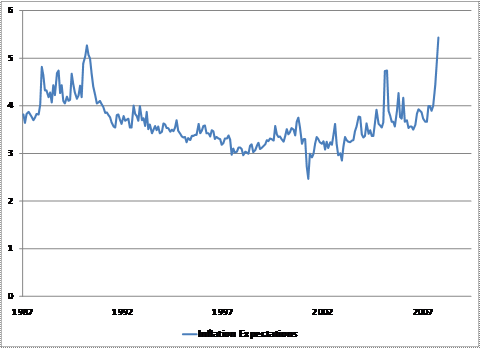
If inflation expectations have taken the prominent
This means that delaying
role in guiding future inflation, some difficult policy situations
could arise. It is generally expected that more slack in the labor
force should ease inflation. But Bernanke and Mishkin have argued that
inflation has become less responsive to the unemployment gap, while
inflation expectations have grown in importance. That means it may be
more difficult to lower inflation and inflation expectations once they
become elevated. If inflation is less responsive to labor slack, more
slack – that is, higher unemployment - will be needed to lower
inflation (the measure of this tradeoff is often referred to as the
sacrifice ratio).
convincing actions that would show that the Fed can contain price
levels would require a more severe response further down the road. A
credibly tough monetary policy would be a more manageable task if the
economy was recovering from a recession, instead of what looks like the
early stages of a contraction. Add in credit markets where
counter-party fear still dominates, an unemployment rate still rising,
and a presidential race looming, and the Fed seems to be left with few
effective responses
Happy Birthday!
The year was 1812 and the United States was at war with England over
freedom of the seas. It was a tumultuous time as Great Britain was
struggling with Napoleon’s invasion of Russia. In 1814, however,
Napoleon was beaten and England turned its attention to the United
States. While many naval battles were fought, the fight eventually
centered on the central part of the U.S. as the British attempted to
split this country in half. Washington, D.C. was taken and then the
Brits “marched” toward Baltimore, where a mere 1,000 patriots manned
the cannons at Fort McHenry, whose guns controlled the harbor. If
Baltimore was to “fall,” the British would have to take Fort McHenry.
The attack commenced on the morning of September 13, 1814 as 19
British ships began pounding the fort with rockets and mortar shells.
After an initial exchange of fire, the Brits withdrew to just outside
the range of Forth McHenry’s cannons and continued their bombardment
for the next 25 hours. Surprisingly, on board one of the British ships
was 35-year-old poet-lawyer Francis Scott Key, who was there arguing
for the release of Dr. William Beanes, a prisoner of the British. Even
though the captain agreed to the release, the two Americans were
required to stay aboard until the attack on Baltimore was over. It was
now the night of September 13th as the bombardment continued.
As twilight deepened, Key and Beanes saw the American flag flying
over Fort McHenry. And, as reprised by famed author Isaac Asimov:
“Through the night, they heard bombs bursting and saw the red glare
of rockets. They knew the fort was resisting and the American flag was
still flying. But toward morning the bombardment ceased, and a dread
silence fell. Either Fort McHenry had surrendered and the British flag
flew above it, or the bombardment had failed and the American flag
still flew.As dawn began to brighten the eastern sky, Key and Beanes stared out
at the fort, trying to see which flag flew over it. He and the
physician must have asked each other over and over, ‘Can you see the
flag?’After it was all finished, Key wrote a four stanza poem telling the
events of the night. Called ‘The Defense of Fort McHenry,’ it was
published in newspapers and swept the nation. Someone noted that the
words fit an old English tune called, ‘To Anacreon in Heaven’ – a
difficult melody with an uncomfortably large vocal range. For obvious
reasons, Key’s work became known as ‘The Star Spangled Banner,’ and in
1931 Congress declared it the official anthem of the United States.Now that you know the story, here are the words. Presumably, the old doctor is speaking. This is what he asks Key:
Oh! say, can you see, by the dawn’s early light,
What so proudly we hailed at the twilight’s last gleaming?
Whose broad stripes and bright stars, through the perilous fight,
O’er the ramparts we watched were so gallantly streaming?
And the rocket’s red glare, the bombs bursting in air,
Gave proof thro’ the night that our flag was still there.
Oh! say, does that star-spangled banner yet wave,
O’er the land of the free and the home of the brave?(‘Ramparts,’ in case you don’t know, are the protective walls or
other elevations that surround a fort.) The first stanza asks a
question. The second gives an answer:On the shore, dimly seen thro’ the mist of the deep
Where the foe’s haughty host in dread silence reposes,
What is that which the breeze, o’er the towering steep.
As it fitfully blows, half conceals, half discloses?
Now it catches the gleam of the morning’s first beam,
In full glory reflected, now shines on the stream
’Tis the star-spangled banner. Oh! long may it wave
O’er the land of the free and the home of the brave!‘The towering steep’ is again, the ramparts. The bombardment has
failed, and the British can do nothing more but sail away, their
mission a failure. In the third stanza I feel Key allows himself to
gloat over the American triumph. In the aftermath of the bombardment,
Key probably was in no mood to act otherwise? During World War I when
the British were our staunchest allies, this third stanza was not sung.
However, I know it, so here it is:And where is that band who so vauntingly swore
That the havoc of war and the battle’s confusion
A home and a country should leave us no more?
Their blood has washed out their foul footstep’s pollution.
No refuge could save the hireling and slave
From the terror of flight, or the gloom of the grave,
And the star-spangled banner in triumph doth wave
O’er the land of the free and the home of the brave.(The fourth stanza, a pious hope for the future, should be sung more slowly than the other three and with even deeper feeling):
Oh! thus be it ever, when freemen shall stand
Between their loved homes and the war’s desolation,
Blest with victory and peace, may the Heaven – rescued land
Praise the Power that hath made and preserved us a nation.
Then conquer we must, for our cause is just,
And this be our motto —“In God is our trust.”
And the star-spangled banner in triumph doth wave
O’er the land of the free and the home of the brave.I hope you will look at the national anthem with new eyes. Listen to
it, the next time you have a chance, with new ears. Pay attention to
the words. And don’t let them ever take it away . . . not even one.”
Thanks for the reminder Jeff.