But for Europeans the economic implications of an aging population areDemographics are ugly in Europe but worse in Japan and Russia.
stark. The Eurostat report says that in 2008, in the EU's 27 nations,
"there are four persons of working age (15-64 years old) for every
person aged 65 years or over." In 2060 "the ratio is expected to be two
to one."
Thursday, August 28, 2008
Herald Tribune: European Demographics
Wednesday, August 27, 2008
Credit Spreads GetWorse; Not Good.
Some words from Donald Coxe
Donald’s
monthly investment report, entitled “Basic Points” (subtitled “The
Devils & The Deep Blue Sea” for the August 2008 edition) has just
been published and I deemed it opportune to share some of his words of
wisdom with you in the paragraphs below (courtesy of Commodity News and Mining Stocks).1. This is not the end
of the commodity bull market. Bear Stearns, F&F and other crises
will one day seem trivial. The new global middle class that is
repricing commodities never will.2. Remain underweight
the banks and financial stocks that invested heavily in the asset
classes that collectively created a global financial crisis. Despite
the frantic efforts of the Fed and Treasury, new challenges appear each
week. The deleveraging process is accelerating. Those peddling bank
paper perversely insist that these writedowns and bailouts are now so
gigantic that a turning point is near. We think serious investors
should compare this sordid story to the SARS epidemic: when the number
of infected people was rising sharply and rapidly, cautious flyers
asked themselves, “Is this trip necessary?”.3. We recommend that
clients begin taking preliminary positions in companies that stand to
benefit most from the possible onset of realism in US energy policies.
When – not if – offshore
drilling finally gets the nod, the majors and service companies should
benefit enormously. Arctic drilling could be next, from which some
important Canadian companies would benefit, although the technological
problems are formidable, and the pipeline issues have not fully been
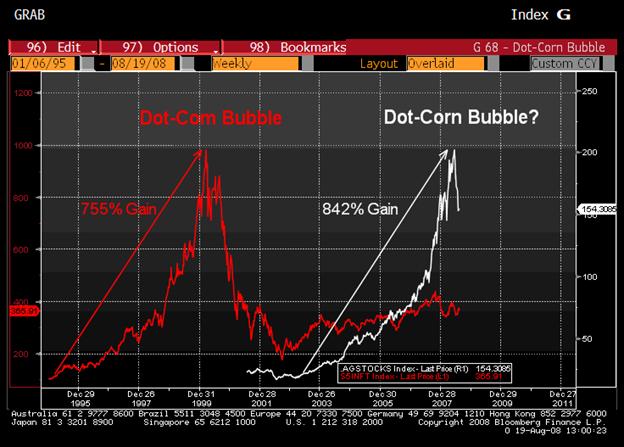
resolved.4. As for corn ethanol,
the producers have been lucky: they benefited from $125 oil, which has
largely offset $5.50 corn. They have also benefited from the plunge in natural gas prices.
As if those weren’t enough to save an industry whose fundamentals had
become so controversial, they also benefited from the collapse of Doha,
because the embarrassing tariff against Brazilian sugar ethanol
survived.5. Natural gas supplies
have exceeded expectations because of the Barnett Shale and coal-bed
methane booms, and because this summer has not been as hot as had been
feared. We recommend the natural gas-oriented producers with
above-average reserve life indices.6. The fertilizer
companies have delivered the most impressive earnings gains of any
commodity group. Nevertheless, their share prices have fallen in recent
weeks along with other commodity groups on days when traders have been
buying banks and dumping commodities. They probably have the most
predictable earnings of all the major commodity sectors, and should be
cornerstones of any resource portfolio. As for the bricks, they are the
farm equipment companies. The roof and windows are the logistic
companies and seed manufacturers.7. The continuation of
the wide spread between Libor and the Fed funds rate, despite the best
efforts of Messrs. Bernanke and Paulson, suggests that the real US
economy will begin to show serious strain because banks are cutting
back on making traditional loans –
they have squandered their resources in untraditional products they
never really understood. Hoarding liquidity is like hoarding corn or
wheat: it triggers shortages and punishes the weakest consumers.8. Gold remains the
asset that offers unique risk reduction features in equity and balanced
portfolios. As to investment strategies, the ETF
outperforms during gold bullion selloffs, but the stocks outperform
when bullion rallies. We believe investors should have exposure to both
kinds of asset, but leave the weighting to be resolved on individual
portfolio risk/reward considerations.9. We keep reading forecasts predicting falling inflation and gold prices because of a US recession,
but insisting that the recession will be neither deep nor long.
Recession actually proved to be an aphrodisiac for gold lovers in the
seventies: each of the recessions back then was accompanied by higher
inflation rates than almost any prominent economist had predicted. We
do not expect a recession so deep that it will stop the march to higher
inflation, with the band music and drum beats coming from the major
emerging economies. We remain negative on longer-term
dollar-denominated nominal bonds. We prefer mid-term, inflation-protected bonds in strong currencies.
Donald Coxe along with David Fuller have been on the powerful market trends accurately since 2003 when I began reading their messages. Both are highly recommended.
From FT.com: gave Kal on the dollar
Either way, imagine the movement on the dollar if there was actually
some positive news out of the US. Most investors are not holding their
breath on this front, but Gavekal notes there have already been a fair
number of positive developments:
1. The market is shrugging off bad news on Fannie and Freddie.
On Wednesday, shares in Fannie dropped 20 per cent and Freddie shed 32
per cent as speculation increased on a possible government bailout.
Yet, despite this, US equities performed well - indeed S&P500
financials actually rallied 1.6 per cent and diversified banks rose by
a notable 3.7 per cent. This has psychological significance, in
Gavekal’s view: investors are now focusing on the positives and less
prone to panic.
2. US exports are on an upswing, expanding at rates not seen since
the 1980. While some argue the trend will peter out if the dollar
continues to rebound, the truth is more complicated. After all, says
Gavekal, we are living in the globalised new age, where companies can
call a bank and buy a hedge to protect themselves from fast-moving
forex trends. This means it takes quite a few years before a currency’s
trend is reflected in exports, and explains, for instance, why the
euro’s rally took a very long time before it began weighing on
Germany’s stellar exports. Moreover, the dollar has a long way to go
before it gets “expensive”.
3. It is a US election year — yet protectionism has not reared its
ugly head. It is hard to win a US election without vowing to protect US
jobs from overseas competition, and regularly bashing China. Yet
recently, protectionist rhetoric has been relatively light, especially
against China. Whether due to the Sichuan earthquake or the Olympics …
or surging US exports, it is a positive sign.
4. Sentiment is improving. Consumer confidence remains near historic
lows, but is improving. A number of polls issued this week - from
ABC/Washington Post to the Bloomberg/LA Times poll - show that
Americans are regaining some optimism about economic prospects. Falling
gas prices is obviously one catalyst - and you can expect oil to
continue to head south.
5. The US tax rebates have not been spent - and unlike a month ago,
it no longer looks like the rebates will go straight into the gas tank.
So, concludes Gavekal, it’s time for a bullish dollar call. “Indeed,
as the short-USD trade unwinds, many foreign borrowers will scramble to
repay their dollar debt; and if there is “good news” from the US, panic
dollar-buying could ensue….”
Tuesday, August 26, 2008
BLOOMBERG: New York Times July Sales Tumble 10.1% on Classifieds
Aug. 26 (Bloomberg) -- New York Times Co., the third-largest
U.S. newspaper publisher, reported revenue fell 10.1 percent in
July as a slumping U.S. economy led to the steepest monthly
declines in retail and classified advertising sales this year.
The NYT all the news that's fit to slant. The Times will not recover until they stop serving as the voice of the far left wing of the democratic party. While even moderate democrats think the paper is leftist it has no chance to start growing again. As long as Pinch keeps trying to please the hollywood celebrities and wealthy trust fund society types he will keep diluting the credibility of his paper's coverage of events.
Monday, August 25, 2008
The weekly comment from John Hussman

John Hussman who has done rather well in this down market by not losing a big chunk of money has some interesting comments and graphs.
Saut: “The 545 People Responsible for America’s Woes”
I urge you to consider the following prose from syndicated columnist Charley Reese:“Politicians are the only people in the world who create problems
and then campaign against them. Have you ever wondered why, if both the
Democrats and the Republicans are against deficits, we have deficits?
Have you ever wondered why, if all the politicians are against
inflation and high taxes, we have inflation and high taxes? You and I
don't propose a federal budget. The president does. You and I don't
have the Constitutional authority to vote on appropriations. The House
of Representatives does. You and I don't write the tax code. Congress
does. You and I don't set fiscal policy. Congress does. You and I don't
control monetary policy. The Federal Reserve Bank does.“One hundred senators, 435 congressmen, one president and nine
Supreme Court justices - 545 human beings out of the 300 million - are
directly, legally, morally and individually responsible for the
domestic problems that plague this country. I excluded the members of
the Federal Reserve Board because that problem was created by the
Congress. In 1913, Congress delegated its Constitutional duty to
provide a sound currency to a federally chartered but private central
bank. I excluded all the special interests and lobbyists for a sound
reason. They have no legal authority. They have no ability to coerce a
senator, a congressman or a president to do one cotton-picking thing. I
don't care if they offer a politician $1 million dollars in cash. The
politician has the power to accept or reject it.
read it all here
Perfect for the Throw the bums out effort. Vote against all incumbents of both parties. Send a message to Washington.
BCA: No US recovery in site.
Massive policy easing and fiscal stimulus have not been
sufficient to offset the drags from a housing bust and squeeze on
consumption.
Friday, August 22, 2008
Fullermoney: Psychology and the market pictured
"If you don't know who you are the market is a very expensive place to find out."
Adam Smith in _THE MONEY GAME_
thanks to Fullermoney for the image
Wednesday, August 20, 2008
Doesn't this seem like Obama's economic plan?
Perverse monetary policy was the greatest cause of the Great
Depression. But five non-monetary missteps were important in making the
Depression great, and the same missteps damaged the global economy as
well. While many are thinking about the Depression, few seem concerned
about replicating these Foolish Five today:
Very Cool
Scientists have succeed in replicating flu pandemic antibodies from 90 year old survivors
Monday, August 18, 2008
Friday, August 15, 2008
Recoupling Anyone?
Mish links to some Bloomberg articles describing the rapidly slowing economies out side of the US. Sort of a Recoupling story.
Thursday, August 14, 2008
Boomers Keep Your Fingers Crossed That One Of These Works
BOSTON (MarketWatch) -- Help finally could be on the way for victims of Alzheimer's disease.
After decades of arduous work, drug makers and academic researchers
believe they've made considerable progress in bringing a new generation
of treatments to market that may ease symptoms of the devastating brain
disease and might even stop its progression.
Wednesday, August 13, 2008
Just when you thought it was safe to go back in the water!


Click the link below to see the implications of these charts
Calculated Risk: Subprime and Alt-A: The End of One Crisis and the Beginning of Another
Tuesday, August 12, 2008
Bespoke on Tech sector seasonality
With nearly a six percent gain over the last week and a half,
Technology has been one of the market's best performing sectors
recently. Based on its seasonal trading patterns, strength in tech
stocks may continue.

Tuesday, August 5, 2008
Morgan Stanley to freeze Home Equity Lines of Credit
Morgan Stanley, the second-biggest
U.S. securities firm, told thousands of clients this week that
they won't be allowed to withdraw money on their home-equity
credit lines, said a person familiar with the situation.Most of the clients had properties that have lost value,
according to the person, who declined to be identified because
the information isn't public. The New York-based investment bank
will review home-equity lines of credit, or HELOCs, monthly from
now on, the person said yesterday.
The government goes through all these basically socialist bailouts of the big banks but the money just disappears and never comes out of those banks and flows into the rest of the system and bank credit is just not available to average people. The demonstrated incompetents and hucksters on Wall Street get away clean and the taxpayer gets boned. Not even a box of chocolates included.
Monday, August 4, 2008
CRB Index sharply lower on Oil and grain drop.
Plunging prices for cocoa, natural
gas and sugar are sending the Reuters/Jefferies CRB Index of 19
commodities to it biggest one-day decline since March.
Friday, August 1, 2008
Bloomberg :Home Prices Fell in 23 of 25 U.S. Metro Areas in May
Aug. 1 (Bloomberg) -- Home prices fell in 23 of 25 U.S.
metropolitan areas in May from a year earlier as foreclosure
sales pushed down values and most areas remained mired in the
housing recession.
Sacramento had the biggest price drop, falling 31 percent
from May 2007. Las Vegas declined 29.5 percent, San Diego 27.2
percent, St. Louis 26.9 percent and Phoenix 25.8 percent, said
real estate data company Radar Logic Inc. Sales rose in 22 areas
in May from April, driven by ``motivated'' sellers including
banks, the company said.