Thursday, October 30, 2008


Tuesday, October 28, 2008

Why the Republicans are going to get stomped.
From the Club For Growth:
I lifted this in its entirety because the writer is so right. This is precisely why there is a danger of a one party Congress for the next 4 years and why the Republicans deserve to be wiped out this year. I say this as someone who usually votes Republican. Hat tip Instapundit.Dumbest Quote of the Year!
Asked whether Ted Stevens can still win, Alaska Rep. Don Young told the Anchorage Daily News [emphasis mine]:
"I think he can win. He's the best thing for that, for the Senate. Alaskans know this.
"[...]I think that's going to be, you know, a matter of opinion. I can remember Richard Nixon, you know, his years of service, what he's done, and everybody were ridiculing him and he ended up being the greatest president in the history of our century.
Arrogance has blinded Young so badly, he thinks it's okay for a convicted felon to serve in the Senate. And his Nixon quote? Astounding.
Monday, October 27, 2008
NIghtmare in currency land
Europe on the brink of currency crisis meltdown
A worrisome article you can find it all here.Stephen Jen, currency chief at Morgan Stanley, says the emerging market crash is a vastly underestimated risk. It threatens to become “the second epicentre of the global financial crisis”, this time unfolding in Europe rather than America.
Austria’s bank exposure to emerging markets is equal to 85pc of GDP – with a heavy concentration in Hungary, Ukraine, and Serbia – all now queuing up (with Belarus) for rescue packages from the International Monetary Fund.
Exposure is 50pc of GDP for Switzerland, 25pc for Sweden, 24pc for the UK, and 23pc for Spain. The US figure is just 4pc. America is the staid old lady in this drama.
Amazingly, Spanish banks alone have lent $316bn to Latin America, almost twice the lending by all US banks combined ($172bn) to what was once the US backyard. Hence the growing doubts about the health of Spain’s financial system – already under stress from its own property crash – as Argentina spirals towards another default, and Brazil’s currency, bonds and stocks all go into freefall.
Broadly speaking, the US and Japan sat out the emerging market credit boom. The lending spree has been a European play – often using dollar balance sheets, adding another ugly twist as global “deleveraging” causes the dollar to rocket. Nowhere has this been more extreme than in the ex-Soviet bloc.
The region has borrowed $1.6 trillion in dollars, euros, and Swiss francs. A few dare-devil homeowners in Hungary and Latvia took out mortgages in Japanese yen. They have just suffered a 40pc rise in their debt since July. Nobody warned them what happens when the Japanese carry trade goes into brutal reverse, as it does when the cycle turns.
Friday, October 24, 2008
Just the guy who won
Stolen from Fullermoney:
How the bailout works...
Young Chuck moved to Texas and bought a Donkey from a farmer for $100.
The farmer agreed to deliver the Donkey the next day.
The next day the farmer drove up and said, 'Sorry son, but I have some bad news, the donkey died.'
Chuck replied, 'Well, then just give me my money back.'
The farmer said, 'Can't do that. I went and spent it already.'
Chuck said, 'Ok, then, just bring me the dead donkey.'
The farmer asked, 'What ya gonna do with him?
Chuck said, 'I'm going to raffle him off.'
The farmer said, 'You can't raffle off a dead donkey!'
Chuck said, 'Sure I can Watch me. I just won't tell anybody he's dead.'
A month later, the farmer met up with Chuck and asked, 'What happened with that dead donkey?'
Chuck said, 'I raffled him off. I sold 500 tickets at two dollars a piece and made $998.'
The farmer said, 'Didn't anyone complain?'
Chuck said, 'Just the guy who won. So I gave him his two dollars back.'
Chuck now leads the US bank bailout team.
Wednesday, October 22, 2008
The Fourth Estate takes over as Obama Campaign manager
From Gateway Pundit: Instapundit:
This election has been hijacked but not by Obama or his staff. The perpetrator is the Main Stream Media. The media is going to elect a man they have not investigated at all. They are not doing it out of malice but out of a desire to write stories about the healing of America's racial wounds and the symolism of the election. Everyone in the media is fulfilling a fantasy by electing a symbol and they cannot allow that to be tarnished or tainted. So the media just ignores Ayers and Bombing Bernadine and other curiosities that a normal candidate of either party would have to explain. Barack Obama is charming and a stirring orator but what else? I don't know because the fourth estate abondoned the task of providing information and became a propagandist. Shame on them.
Sick. Only 14% Of McCain Media Coverage Is Positive
Of course this comes as no surprise.
The media has been unusually hard on John McCain.
The Politico reported:
The
good news for John McCain? He's now receiving as much attention from
the national media as his Democratic rival. The bad news? It’s
overwhelmingly negative.
Just 14 percent of the stories about John McCain from the conventions through the final presidential debate were positive in tone,
according to a study released today, while nearly 60 percent were
negative—the least favorable coverage of any of the 4 candidates on the
ticket.
This election has been hijacked but not by Obama or his staff. The perpetrator is the Main Stream Media. The media is going to elect a man they have not investigated at all. They are not doing it out of malice but out of a desire to write stories about the healing of America's racial wounds and the symolism of the election. Everyone in the media is fulfilling a fantasy by electing a symbol and they cannot allow that to be tarnished or tainted. So the media just ignores Ayers and Bombing Bernadine and other curiosities that a normal candidate of either party would have to explain. Barack Obama is charming and a stirring orator but what else? I don't know because the fourth estate abondoned the task of providing information and became a propagandist. Shame on them.
Sunday, October 19, 2008
Libor Rate Improving Slowly

From Bespoke a chart showing the overnight libor improving substantially. Longer maturity libor rates also improved but more slowly. Such improvement is very good news, suggesting a loosening of the locked up credit markets.
Friday, October 17, 2008

Thursday, October 16, 2008
If you invest I suggest you read Hussman
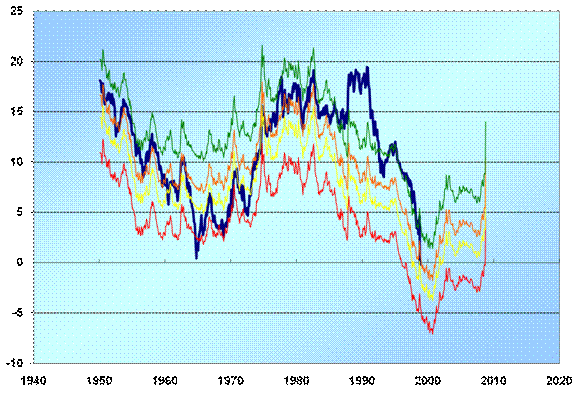
Hussman ;
Long-term shareholders will recognize the following chart, which is an update of our 10-year total return projections for the S&P 500 Index ( standard methodology ). The heavy line tracks actual 10-year total returns. Note that the total return for the past decade has been zero, right in the mid-range of what we projected at the time. The green, orange, yellow, and red lines represent the projected total returns for the S&P 500 assuming terminal valuation multiples of 20, 14 (average), 11 (median) and 7 times normalized earnings. Stocks are now at the same valuations that existed at the 1990 bear market low. Relative to 30-year Treasury yields, the S&P 500 is priced to deliver the highest excess return since the early 1980's.
Wednesday, October 15, 2008
I am calling for a low this Quarter
IN TAXES! '09 is going to mark a turning point to the upside.
| Partial History of U.S. Federal Income Tax Rates Since 1913 | ||||
|---|---|---|---|---|
| Applicable Year | Income brackets | First bracket | Top bracket | Source |
| 1913-1915 | - | 1% | 7% | Census |
| 1916 | - | 2% | 15% | Census |
| 1917 | - | 2% | 67% | Census |
| 1918 | - | 6% | 73% | Census |
| 1919-1920 | - | 4% | 73% | Census |
| 1921 | - | 4% | 73% | Census |
| 1922 | - | 4% | 56% | Census |
| 1923 | - | 3% | 56% | Census |
| 1924 | - | 1.5% | 46% | Census |
| 1925-1928 | - | 1.5% | 25% | Census |
| 1929 | - | 0.375% | 24% | Census |
| 1930-1931 | - | 1.125% | 25% | Census |
| 1932-1933 | - | 4% | 63% | Census |
| 1934-1935 | - | 4% | 63% | Census |
| 1936-1939 | - | 4% | 79% | Census |
| 1940 | - | 4.4% | 81.1% | Census |
| 1941 | - | 10% | 81% | Census |
| 1942-1943 | - | 19% | 88% | Census |
| 1944-1945 | - | 23% | 94% | Census |
| 1946-1947 | - | 19% | 86.45% | Census |
| 1948-1949 | - | 16.6% | 82.13% | Census |
| 1950 | - | 17.4% | 84.36% | Census |
| 1951 | - | 20.4% | 91% | Census |
| 1952-1953 | - | 22.2% | 92% | Census |
| 1954-1963 | - | 20% | 91% | Census |
| 1964 | - | 16% | 77% | Census |
| 1965-1967 | - | 14% | 70% | Census |
| 1968 | - | 14% | 75.25% | Census |
| 1969 | - | 14% | 77% | Census |
| 1970 | - | 14% | 71.75% | Census |
| 1971-1981 | 15 brackets | 14% | 70% | IRS |
| 1982-1986 | 12 brackets | 12% | 50% | IRS |
| 1987 | 5 brackets | 11% | 38.5% | IRS |
| 1988-1990 | 3 brackets | 15% | 33% | IRS |
| 1991-1992 | 3 brackets | 15% | 31% | IRS |
| 1993-2000 | 5 brackets | 15% | 39.6% | IRS |
| 2001 | 5 brackets | 15% | 39.1% | IRS |
| 2002 | 6 brackets | 10% | 38.6% | IRS |
| 2003-2008 | 6 brackets | 10% | 35% | IRS |
Saturday, October 11, 2008
Charts from Fullermoney


I am a paid up subscriber of the Fullermoney service and am using some of their charts from Friday. Click the chart for a larger image.
The first chart is the VIX an index measuring volatility conditions in the market. This is the highest level since the index started trading which was after the 87 crash. Estimates of the crash day vol are higher still.
The second chart was sent in by a Fullermoney subscriber and show the current S&P relative to its 200 day moving average. One cannot know how far down this chart could drop but levels this low do usually mark major lows.
Thursday, October 9, 2008
Gold Price Crosses Above S&P500
I wrote this here in January:
Let's hope it stops soon.Tuesday, January 8, 2008
FT: Gold is the new global currency
The Financial Times editorial today claims :
Gold is the new global currencyThe world’s major economies have experienced rapid money supply growth of 10 per cent plus per annum in recent years. The Fed remains the world’s biggest holder of gold, yet supplies of the metal are no longer growing annually. If gold is a finite currency, its value against not just the dollar, but sterling and the euro too, should rise.I made a note of the gold price rise in several currencies in this post last week. I traded in gold during the big rise in the 70's and the climax in the early 1980's. The single most reliable sign of a short term top in gold was an article on the front page of the local newspaper ( The Dallas Morning News ) declaring gold makes new all time high. We are not there yet but, if you see mainstream non-financial news coverage of a new high in gold prepare for a sharp setback. The chart above is from Google Trends and does not indicate an explosion of interest in gold by the general searching public yet. I believe this trend has a good ways to go and would look for a lot of press attention when the market cracks $900, and enormous attention when it cracks $1000. Those will be times to expect a big correction. When the gold price crosses above the SP500 price will be another big news day.

Monday, October 6, 2008
FT: Fed's First Foray Into Unsecured Lending
continued at FTThe Federal Reserve is working with the US Treasury on plans for a dramatic move into unsecured lending in the hope that this extreme step could help bring credit markets back to life.
As well as unsecured lending to banks, this could lead to the Fed directly purchasing commercial paper or funding a special purpose vehicle set up to do this.

Subscribe to:
Posts (Atom)