Oh and Mr. JamesTaranto the author of the article is being a little too pc. Jim you wrote a fine article, as usual, except you missed the whole point by throwing the Islamist view a bone.Having his own party liberates Mr. Wilders to speak his mind. As he sees it, the West suffers from an excess of toleration for those who do not share its tradition of tolerance. "We believe that -- 'we' means the political elite -- that all cultures are equal," he says. "I believe this is the biggest disease today facing Europe. . . . We should wake up and tell ourselves: You're not a xenophobe, you're not a racist, you're not a crazy guy if you say, 'My culture is better than yours.' A culture based on Christianity, Judaism, humanism is better. Look at how we treat women, look at how we treat apostates, look at how we go with the separation of church and state. I can give you 500 examples why our culture is better."
He acknowledges that "the majority of Muslims in Europe and America are not terrorists or violent people." But he says "it really doesn't matter that much, because if you don't define your own culture as the best, dominant one, and you allow through immigration people from those countries to come in, at the end of the day you will lose your own identity and your own culture, and your society will change. And our freedom will change -- all the freedoms we have will change."
Sunday, November 30, 2008
Geert Wilders is a Hero


Powerline: Muslims "worry about image"
I believe the image of Islam is just fine having been polished up by the typical murderous mayhem of its adherents. After many years of this barbarous behavior with no outcry from "moderate" Muslims one is led to the conclusion that "moderate" Muslims are cowards or non-existent.
Mark Steyn in his book America Alone asks a qquestion that goes something like this: If an Islamic terrorist, a moderate muslim , Santa Claus, and the Easter Bunny all arrive at an intersection where a hundred dollar bill is lying in the street who will get the hundred dollars? ----- the terrorist because the others are all mythical creatures.
Friday, November 28, 2008
Unchartd territory? Not so much.
Market In "Uncharted Territory"? Only If You're An Idiot
Fund manager John Hussman takes aim at one of the ludicrous excuses that is making its way around Wall Street: All past losses and future uncertainty can be forgiven because the market is in "uncharted territory." Please.
Go to both links, they cover it better than I would.
Wednesday, November 26, 2008
Monday, November 24, 2008
How are stock mutual funds doing?
Every Stock Mutual Fund Has Lost Money in
2008, Except One
Oh by the way, that one is flat for the year. None are up. Glad I am paying that 2% fee for professional package.
Saturday, November 22, 2008
WSJ: Auto Makers Alreadt Bankrupt
The Auto Makers Are Already Bankrupt
Admitting the obvious is their best chance to restructure.
Friday, November 21, 2008
Panic in Bond Market and Banking System
This is almost certainly a panic extreme hedge against some risk in a non exchange traded derivative that is causing capital impairment charges. Here is a link talking about this issue:
money at aol
I don't want to pass rumors so I won't give names but this is extraordinary and a really desperate protective measure. Desperate enough that gold is up.
Thursday, November 20, 2008
Barrons: Sum Micro trading less than cash
For Sun Microsystems (JAVA), it has come down to this: the stock is now trading for the net value of the cash and investments on its balance sheet.
As of September 30, the company had $2.63 billion in short-term cash and investments. Add in $490 million in long-term investments, and back out $694 million in long-term debt, and you get net cash of $2.486 billion.
JAVA shares today have dropped another 34 cents, or 9.2%, to $3.38. It’s current market cap: $2.49 billion. Since announcing the headcount reduction plan, the stock is down 17%. Ergo, you in theory could buy Sun today, pay off holders and the debt with the existing cash, and get the entire company for nothing.
Now, I know, I know, that does not include the costs of the company’s plan to cut 5,000-6,000 jobs. So there’s actually less cash to go around than meets the eye. Nonetheless, the stock’s ongoing swoon is a startling reminder that any stock not trading at zero can always go lower.
Wednesday, November 19, 2008
Bespoke: On high yield bonds
Bespoke is really on its game today. Credit spreads continue to be a big problem as they demonstrate in these charts. Click to their site to read their commentary.
Monday, November 17, 2008
Poll on auto bailout
| Should We Bail Out The U.S. Automakers? | ||
 | ||
| Selection | Votes | |
| Yes, they're vital industries. |  3% 3% | 338 |
| No, let them fail. That's capitalism! |  97% 97% | 9,654 |
| | |
| 9,992 votes total | ||
| pollcode.com free polls | ||
Friday, November 14, 2008
Solving the Auto company problem

Now remember all these are wage rates for manufacturing in the USA.
Congress is (still) an embarassment
Wednesday, November 12, 2008
Good Read On Hedge Funds
Trimming the Hedgies
November 12, 2008 ·
M y opinion is the hedgies got too big and too greedy to turn down the money offered them by late to the party "me too" bankers. Arb strategies are not always scalable to bigger size so less profitable but growable strategies are utilized and the returns jacked up with huge leverage. At 40 to 1 a 3% retracement is a 100% plus loss. Live by the sword die by the sword.Going through my daily abnormal returns browse these days makes me want to misquote Admiral Beatty at the Battle of Jutland: there seems to be something wrong with our bloody hedge funds. They’re crapping out left and right. What gets me is not just that they are all doing it at the same time, which is astonishing enough, it is that it seems to be getting worse. Given half decent risk management, this should not be happening. I was aware of the existence of hedge fund beta where it comes to Quants, but I had always assumed there was sufficient diversity of opinion within the rest of the popular hedge fund strategies, particularly in equity long short, so that they would have some sort of diversity in their returns. I had also assumed that these guys were smart and flexible enough to be able to stop themselves out, to switch stuff around and refashion their portfolios to find something that works. At the very least, they could have just stopped doing anything, cover shorts, sell longs, and go flat.
This is clearly not the case, and I have not yet found a convincing explanation for it. The Citadels, Atticus(-ses, Attici?), Tontines, Fortresses of this world seem to be deer in headlights. Their performance is deteriorating over the course of this year, not stabilising. September was the worst month ever, we were told, so it would not be a very difficult decision to retrench, take some action, gross down and change orientation some way. Instead we find out that October was worse.
Good for Mexico
From the FT:
Mexico hedges almost all of its oil exports for the coming year
By Javier Blas in London and Adam Thomson in Mexico City
Published: November 11 2008 02:00 | Last updated: November 11 2008 02:00
Mexico is taking steps to protect itself from the oil price remaining below $70 a barrel in the clearest sign yet of the concerns of producer countries at the impact of the global economic slowdown on their revenues.
The world's sixth biggest oil producer hedged almost all of next's year oil exports at prices ranging from $70 to $100 at a cost of about $1.5bn (£961m) through derivatives contracts, according to bankers familiar with the deal.
The cover is far higher than the country - which relies on oil for up to 40 per cent of government revenue - usually seeks. Last year, Mexico hedged 20-30 per cent of its exports.
Mexico's finance ministry yesterday declined to comment but said in its latest quarterly report that its oil income stabilisation fund spent about $1.5bn on "financial investments, as part of the measures taken for risk management".
Oil prices hit an all-time high of $147.27 a barrel in July but have since fallen to less than $65 as the global economy cools. In London yesterday, oil ended the session up $1.73 at $59.08 a barrel.
Tomas Lajous, a strategist at UBS in Mexico City, said the trades appeared to have occurred in late August and early September. "The hedge is very good news . . . a presumed cost of some $1.5bn is immaterial relative to risks," he said.
Shooting At Paulson
The critics, most of whom are not qualified to carry Paulson's brief case, are all over him because the problems are not over yet. After all the TARP was passed way back on October 2nd and we still have problems. I mean really, what is he dawdling over ? As far as they can see it is only the biggest financial collapse in 50 years. Jeesh!
Fullermoney today points out a terrific letter by Tim Price that reminds us to step back from the emotion of the moment and put this extraordinary situation we have into long term perspective and judge it against history before making ad lib decisions. Link here and very highly reccommended.
Another perspective of Mauboussin‟s that seems, at face value, to be bad news but which is almost certainly extremely positive for current investors is the paucity of returns over the recent past. He charts the rolling 10 year returns for large cap stocks:
“Over the past century-plus, the market has tended to bottom out around zero percent rolling ten year returns. That happened in the 1930s and 1970s, and that is where we are today. The rolling 10 year figure is worth examining for psychological reasons, too. If the average investor is in a mutual fund, they have lost money after taking fees into consideration. Further, most investors lose an additional 200 basis points due to bad timing. So on a dollar-weighted basis, the average investor has been down substantially in the US stock market in the past decade. That is very psychologically damaging.
Friday, November 7, 2008
Why stocks maybe are not cheap
It comes down to apples to oranges but I much prefer the oranges to Professor Siegel's apples because he uses forward earnings estimates and they are notoriously unreliable.Jeremy Siegel's Mistake: Why Stocks Are NOT "Dirt Cheap"
Yesterday, we noted that Wharton professor Jeremy Siegel's "fair value" estimate for the S&P 500 is a startling 1380, which is about 40% higher than most other estimates (Robert Shiller, Jeremy Grantham, Andrew Smithers, John Hussman, et al). Prof Siegel, who is now a pitch man for WisdomTree funds, uses this estimate to conclude that stocks are "dirt cheap."
The other experts, meanwhile, who use a consistent, historically predictive, and fully explained methology, estimate that fair value is around 900-1000, about where we are now. In their view, stocks are just fairly valued.
So who's right?
Wednesday, November 5, 2008
credit car shoe finally dropping?
Credit Card Bond Sales Plunge to Zero, First Time in 15 YearsBy Sarah Mulholland
Nov. 5 (Bloomberg) -- Credit card companies were shut out of
the market for bonds backed by customer payments in October for
the first time in more than 15 years, as investors shunned the
debt amid the global credit freeze.
More problems if banks cannot securitize credit card debt. They will have to withdraw credit from another section of the economy.
Monday, November 3, 2008
Hussman on Value Dinosaurs
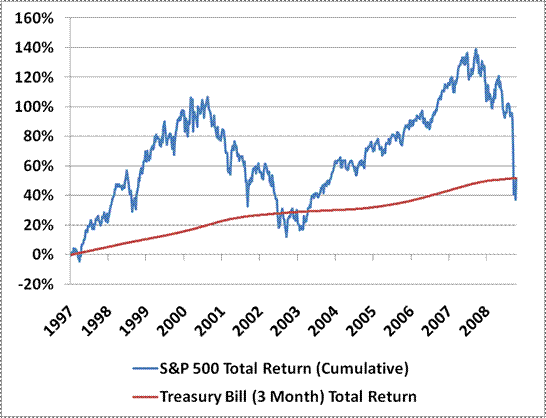
John Hussman this week points out that 3 month bills have matched the S&P500 for ten years with considerably less volatility. He also notes Buffett and Grantham and Neff are dipping there toes in for value. That is not bad company swim with.
Hussman:
In my view, we are entering an environment that provides good conditions for value-based stock selection, because the speculative garbage has been increasingly shown to be exactly that. I also expect that we will be able to accept a much more typical exposure to market risk in the next market cycle than we were able to take in the recent one.
For anyone with a sense of long-term market history and an understanding of what drives sustainable long-term investment returns (as opposed to the ephemeral type we've seen in recent years), current valuations are like old friends. That's why “value dinosaurs” like Warren Buffett, Jeremy Grantham, and John Neff have come out of what seemed like extinction. Grantham recently noted that he is “filtering money in slowly” because, as he puts it, “If stocks are attractive and you don't buy, you don't just look like an idiot, you are an idiot.”