Click here to read the whole thing.
Stanford Law Review has a great interview with Warren Buffett's longstanding partner, Charlie Munger. Munger offers much less corn pone and more direct opinion than Buffett does.
The entire piece is very much worth reading, but I wanted to hone in on some key topics. One is the neglect of the role of what amounts to accounting fraud in this mess. Much of this is technically not fraud under the current regime but would be if the standards of 20 years ago were still in place. We now live in a world where everyone knows that the authorities simply will not take down any of the Big Four. Four is now deemed to be the minimum number of big accounting firms permissible. So we de facto have accounting firms "too big to fail", which means "too big to be asked to eat much liability, not matter how indefensible their conduct." So if they do something bad, they might have to fire a few partners and pay a moderate fine.
So effectively, we live in a world that echoes the Nixon Presidency. If the Big Four does it, it must be legal.
Showing posts with label buffett. Show all posts
Showing posts with label buffett. Show all posts
Thursday, May 14, 2009
Charlie Munger Being Charlie Munger
Thanks to Between The Hedges for poin6ing out this article at Naked Capitalism:


Monday, November 3, 2008
Hussman on Value Dinosaurs
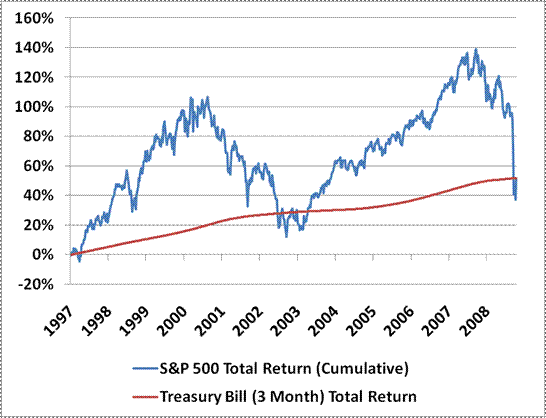
John Hussman this week points out that 3 month bills have matched the S&P500 for ten years with considerably less volatility. He also notes Buffett and Grantham and Neff are dipping there toes in for value. That is not bad company swim with.
Hussman:
In my view, we are entering an environment that provides good conditions for value-based stock selection, because the speculative garbage has been increasingly shown to be exactly that. I also expect that we will be able to accept a much more typical exposure to market risk in the next market cycle than we were able to take in the recent one.
For anyone with a sense of long-term market history and an understanding of what drives sustainable long-term investment returns (as opposed to the ephemeral type we've seen in recent years), current valuations are like old friends. That's why “value dinosaurs” like Warren Buffett, Jeremy Grantham, and John Neff have come out of what seemed like extinction. Grantham recently noted that he is “filtering money in slowly” because, as he puts it, “If stocks are attractive and you don't buy, you don't just look like an idiot, you are an idiot.”
Tuesday, May 6, 2008

Friday, May 2, 2008
Can Funds Go Wrong with Buffett as Their Guide?
A Morningstar article On Buffett and funds that follow his strategy.
I am heading out to the Berkshire annual meeting tomorrow. I will try to remeber what I hear and post on it.
I am heading out to the Berkshire annual meeting tomorrow. I will try to remeber what I hear and post on it.
Sunday, April 6, 2008
Quote
"A pack of lemmings looks like a group of rugged individualists compared with Wall Street when it gets a concept in its teeth."
Warren Buffett, courtesy of Pradeep
(courtesy of Fullermoney)
Warren Buffett, courtesy of Pradeep
(courtesy of Fullermoney)
Wednesday, March 26, 2008
Buffett or Schwarzman
Bloomberg: Buffett Shows Schwarzman Berkshire's Free Money Beats LBO Model
March 26 (Bloomberg) -- Credit-market gridlock has trapped Stephen Schwarzman, who relies on lenders to fund acquisitions, while leaving Warren Buffett free to pursue the debt-free deals that have helped make him the world's richest person.
Buffett, chairman of Omaha, Nebraska-based Berkshire Hathaway Inc., has $59 billion in cost-free money from insurance premiums to invest. Schwarzman's New York-based Blackstone Group LP, manager of the biggest private-equity fund, is being forced to bypass Wall Street banks after they stopped financing most leveraged buyouts.
Buffett and Schwarzman each takes a different approach to the same goal: finding companies they consider undervalued. Investors are betting Buffett's model will prevail, at least for now. Berkshire climbed 5.4 percent since the subprime-lending crisis sent the Standard & Poor's 500 Index tumbling as much as 19.7 percent from its Oct. 9 peak. Blackstone dropped 43 percent in the same period.
``There's a massive, massive advantage for Buffett in this kind of market,'' said Guy Spier, chief investment officer of New York-based hedge fund Aquamarine Capital Management LLC. ``All the leveraged finance has dried up, so he's going to have a much better time finding things to buy.''
Disclosure I own both securities, Berkshire for many years Blackstone for a few days.
Wednesday, March 5, 2008
Mish on Ambac: "Thud"

Mike Shedlock on the Ambac announcement and following price flop.
Best two lines:
Splitting a rotten apple in two does not give you half a good apple.I wonder when the rating agencies are going to become shorts. Surely they are accomplices in the intellectual fraud that is the rating of CDO's. Mr. Buffett I know you have been a fan of and an investor in Moody's but, I think it is time to sell before the lawsuits hit.
You cannot stay in business, by not doing business, no matter what the business is.
Saturday, March 1, 2008
Berkshire Annual Report and Shareholder letter.
Berkshire annual and quarterly reports.
Link to all Buffett's letters to shareholders
A couple of interesting excerpts:
Link to all Buffett's letters to shareholders
A couple of interesting excerpts:
and
Our direct currency positions have yielded $2.3 billion of pre-tax profits over the past five years,
and in addition we have profited by holding bonds of U.S. companies that are denominated in other
currencies. For example, in 2001 and 2002 we purchased €310 million Amazon.com, Inc. 6 7/8 of 2010 at
57% of par. At the time, Amazon bonds were priced as “junk” credits, though they were anything but.
(Yes, Virginia, you can occasionally find markets that are ridiculously inefficient – or at least you can find
them anywhere except at the finance departments of some leading business schools.)
The Euro denomination of the Amazon bonds was a further, and important, attraction for us. The
Euro was at 95¢ when we bought in 2002. Therefore, our cost in dollars came to only $169 million. Now
the bonds sell at 102% of par and the Euro is worth $1.47. In 2005 and 2006 some of our bonds were
called and we received $253 million for them. Our remaining bonds were valued at $162 million at
yearend. Of our $246 million of realized and unrealized gain, about $118 million is attributable to the fall
in the dollar. Currencies do matter.
We made one large sale last year. In 2002 and 2003 Berkshire bought 1.3% of PetroChina forWarren Buffett is known as a long term buy and hold investor but he has been a great bond trader over the years.
$488 million, a price that valued the entire business at about $37 billion. Charlie and I then felt that the
company was worth about $100 billion. By 2007, two factors had materially increased its value: the price
of oil had climbed significantly, and PetroChina’s management had done a great job in building oil and gas
reserves. In the second half of last year, the market value of the company rose to $275 billion, about what
we thought it was worth compared to other giant oil companies. So we sold our holdings for $4 billion.
Tuesday, February 19, 2008
Jeff Saut: "Wait For The Fat Pitch"
I have found Jeff Saut at Raymond James to be a very useful read over the years, and I have profited from his advice. This weeks column is worth a read.
Warren Buffett has often quoted legendary baseball player Ted Williams, who stated, “Waiting for the right pitch is the most important thing for a batter.” Of course, Mr. Buffett modifies Williams’ quote for the investing world by noting, “There are no called strikes so you can watch stocks come by and wait and wait until the right pitch and no one is going to call a strike (on you).” Buffett goes on to say, “Wait for the fat pitch and then swing for the fences!” And last week the Oracle of Omaha “swung,” as the 77-year old investor disclosed that he has become the largest shareholder of Kraft (KFT/$31.33), as well as offering to take $800 billion of municipal bonds off of the books of troubled insurers. While these moves are anything but altruistic, we do find it interesting that after years of lamenting there was a lack of attractive investment opportunities, Mr. B has suddenly sprung into action.We can do worse than follow Mr. Buffett's lead. (Barry Ritholtz might disagree.) We can also do worse than follow Mr. Saut's advice.
Tuesday, February 12, 2008
Buffett On the Prowl
Mr. Buffett sees opportunity in the Muni bond insurance business and throws out a bid for business.
Bloomberg has the story:
Video interview with Warren Buffett from the Financial Post in Canada
Bloomberg has the story:
Billionaire investor Warren Buffett said he offered to shore up $800 billion of municipal bonds guaranteed by troubled MBIA Inc., Ambac Financial Group Inc. and FGIC Corp. in a bid to gain 33 percent of the debt insurance market.Apparently one of the firms has already rejected the deal. But regulators and municipalities are going to be all for it. This move won't help the CDO mortgage market but it would stop the problems in the muni market and that means one less risk of cascading credit woes. A good deal for Buffett, a good deal for the public and for regulators and tough sh__ for the shareholders and management of the companies listed above.
Video interview with Warren Buffett from the Financial Post in Canada
Tuesday, February 5, 2008
Business Week: What Would Buffett Buy Now?
Good article in Business Week on a stock screen using Buffett like criteria.
The stock of Buffett's company, Berkshire Hathaway (BRKA), topped the broader market in 2007 and 2006 after underperforming for a few years. Longtime Berkshire holders are sitting on impressive gains. Berkshire's book value per share has grown at a compounded annual rate of more than 20% over the past 40 calendar years. If you had invested $10,000 in Berkshire in January, 1968 (the shares closed at $20.50 on the last trading day of that month), your holding would be worth more than $50 million today.
Sixty names emerged when the screen was completed.
Friday, January 25, 2008
Buffett Buying Again
Warren Buffett is buying again, just when others are selling. Bloomberg has this article. My favorite bit of the article:
Imitating the 77-year-old Buffett, who built Omaha, Nebraska-based Berkshire over four decades into a $210 billion company, has been a profitable strategy in the past. Buying what he bought, even months after his purchases, delivered twice the return of the Standard & Poor's 500 Index during the last three decades, according to a study last year by the American University, Washington and University of Nevada, Las Vegas.Twice the S&P for three decades - I cannot even think of a comparable sports record. That is really an astonishing record.
Friday, December 28, 2007
BuffettAgain and This Is A Brilliant Move (Again)
Warren Buffett who has repeatedly been rumored to be buying a piece of this distressed mortgage company or that distressed bond insurer has finally announced a move and as usual it is much smarter than the rumored moves.
The municipal bond market which has been suffering from collateral damage to the subprime mortgage fallout because the formerly AAA rated bond insurers are all suspect and thus the municipal bonds they insure are effectively uninsured now. This "worthless insurance" is causing all kinds of munis to be rerated downward. Some of the problem is explained clearly by Accrued Interest in this post:
The municipal bond market which has been suffering from collateral damage to the subprime mortgage fallout because the formerly AAA rated bond insurers are all suspect and thus the municipal bonds they insure are effectively uninsured now. This "worthless insurance" is causing all kinds of munis to be rerated downward. Some of the problem is explained clearly by Accrued Interest in this post:
And here is Bloomberg on the Buffett announcement:What is a Tender Option Bond (TOB)?
(Alternative title for long-time readers: There's a meteorite that hit the ground near here. I want to check it out. It won't take long.)
Dec. 28 (Bloomberg) -- MBIA Inc. and Ambac Financial Group Inc., the two largest bond insurers, fell in New York Stock Exchange trading after billionaire investor Warren Buffett said he plans to start a rival company to guarantee municipal debt.
Wednesday, December 26, 2007
Buffett On The Prowl Again

Berkshire Hathaway buying:
from Bloomberg:
Dec. 26 (Bloomberg) -- Warren Buffett's Berkshire Hathaway Inc. will pay $4.5 billion to gain control of Marmon Holdings Inc., the Pritzker family's closely held collection of 125 companies, in what may be his biggest non-insurance acquisition.
Chart courtesy of Yahoo. Blue line is Berkshire price growth and red line is SP500
Sunday, November 18, 2007
Buffett and Berkshire
A study of Warren Buffett and Berkshire Hathaway's investment results.
Imitation is the Sincerest Form of Flattery: Warren Buffett and Berkshire Hathaway
a paper by Gerald S. Martin and John Puthenpurackal.
Imitation is the Sincerest Form of Flattery: Warren Buffett and Berkshire Hathaway
a paper by Gerald S. Martin and John Puthenpurackal.
Abstract:The style has to be large cap these days because the amount of money Buffett is managing is so large that investment in small companies would not have a meaningful impact. When investing in smaller companies he buys them entirely.
We analyze the performance of Berkshire Hathaway's equity portfolio and explore potential explanations for its superior performance. Contrary to popular belief we show Berkshire's investment style is best characterized as a large-cap growth. We examine whether Berkshire's investment performance is due to luck and find that beating the market in 28 out of 31 years places it in the 99.99 percentile; however, incorporating the magnitude by which Berkshire beats the market makes the “luck” explanation unlikely even after taking into account ex-post selection bias. After adjusting for risk we find that Berkshire's performance cannot be explained by assuming high risk. From 1976 to 2006 Berkshire's stock portfolio beats the S&P 500 Index by 14.65%, the value-weighted index of all stocks by 10.91%, and the Fama and French characteristic portfolio by 8.56% per year. The market also appears to under-react to the news of a Berkshire stock investment since a hypothetical portfolio that mimics Berkshire's investments created the month after they are publicly disclosed earns positive abnormal returns of 14.26% per year. Overall, the Berkshire Hathaway triumvirates of Warren Buffett, Charles Munger, and Lou Simpson posses' investment skill consistent with a number of recent papers that argue investment skill is more prevalent than earlier papers suggest.
Sunday, October 21, 2007
Warren Buffett Considers Korean Stock Market ‘Still Attractive’

Korea ETF chart courtesy of Stockcharts.com
Buffett said, “The Korean stock market a few years ago was by far the most undervalued market in the world. Since then, there has been a huge advance in the Korean market and the won has appreciated against the dollar. Nevertheless, many Korean stocks still sell at more attractive prices than stocks in other major countries.”
Buffett’s view is quite a contrast to the market concern that Korean stocks may be “overvalued” with KOSPI having surpassed 2,000. In fact, in terms of PER (price earnings ratio), Korean market is still undervalued as Buffett argues. According to Thomson IBES, Korean stock market posted 12.3 PER, lower than the average of emerging markets (15.0) and the average of advanced markets (14.7).
Thursday, October 18, 2007
Buffett Still The best

Buffett continues to show why he has about the best investment record ever. Why is he not emulated more?
From Bloomberg:
Billionaire Warren Buffett said his Berkshire Hathaway Inc. won't buy a stake in Bear Stearns Cos. and that he ``never came close'' to acquiring shares of mortgage lender Countrywide Financial Corp., which fell 61 percent this year. Buffett also said Berkshire sold all its stock in PetroChina Co.
Berkshire paid $488 million for the stake, valued at $3.3 billion at the end of 2006, according to Berkshire's annual report.
Please note Buffett bought most of his shares below 30. He was up almost 700% at year end 2006 and the stock has doubled since then. Buffett's salary is around $100,000 per year, unchanged since the late 70's or so. He is the best bargain in fund management by far.
Sunday, August 26, 2007
Contingent liabilities and pricing tail
Tom Maguire at Just One Minute discusses a Michael Lewis article on pricing an option to cover the risk of an earthquake in both Japan and California. This is the kind of thing Warren Buffett and Ajit Jain have made so much money doing over the last decade or so. The discussion is a good example of the logic involved in estimating contingent probabilities.
Tuesday, August 21, 2007
who is swimming naked
The title is the ending of one of Warren Buffett's favorite sayings " It is not until the tide goes out that you find out who is swimming naked." The tide has gone out in the short term money arena and a few folks are looking redfaced. The Wall Street Journal discusses the SEC looking at irregularities at Sentinel Management Group. This is likely to be only the first not the last instance of suitless swimmers. Thanks to Between The Hedges for pointing out this article.
Tuesday, July 31, 2007
Buffett lightens up on some Petrochina
 Looks like Mr. Buffett still knows what he is doing.
From commentary on the excellent Fullermoney site:
"Warren Buffet has sold some holding on Petro China (stock code 857 ) in Hong Kong Stock Exchange two weeks ago . He bought some relatively large amount of shares 4 years ago at around HK$ 1.6 and now today the share is trading at HK$ 11.30 .
Subscribe to:
Posts (Atom)