Showing posts with label Fed. Show all posts

Tuesday, June 23, 2009

Whoops what happened to inflation?


These charts illustrate the problem facing the central bank in a sharp correction in the economy. no matter how much money they inject into the market if no one wants to spend the money ( refusal of velocity to increase) then growth won't be inflationary.
charts courtesy of Bloomberg and Bank Credit Anayst.

Thursday, April 23, 2009

Tuesday, January 27, 2009

Tim Price takes lessons from the 30's and Murray Rothbard

Tim Price of The Price Of Everything draws lessons from the great depression and Murray Rothbard in this post.

One exerpt:
But the savaging of fractional
reserve banking is only a small part of the message of Rothbard’s “America’s
Great Depression”. Contrary to the received wisdom that interventionist
government (under, Rothbard points out, the administration of Herbert Hoover
for some years before Roosevelt took the presidency) ameliorates and
foreshortens a dismal business depression, Rothbard suggests that the very
intervention so clamorously called for (both then and now) actually extends
and amplifies
it:

Saturday, January 17, 2009

The Ouroboros, Deflation, and 2008

The Ouroboros, Deflation and 2008

2008 was disastrous but fascinating year in the financial trading marketplace. I recall no period with such widespread misunderstanding of market conditions and policy needs. The problems that devastated the markets began to reveal themselves in late 2007 when two Bear Stearns funds collapsed because securities they held could not be sold. Then Libor rates exploded as banks began to take a look at their own portfolios and became suspicious of the portfolios of other banks and stopped lending to one another. This was misinterpreted as tight money so the Fed responded with rate cuts.
But the real cause was a slow realization that bogus triple A rated mortgage securities based on mongrel pools of thousands of subprime mortgages mixed with prime mortgages were grossly mis-rated by ethically challenged, fee seeking, rating agencies. The asset class collapsed and thus seriously impaired bank capital ratios. But not until Bear Stearns failed was this widely recognized. Solvency was the problem not tight money, and that is why Fed rate cutting was not generating any result. They were treating a virus with an antibiotic.
The Ouroboros pictured above is a mythical creature that eats its own tail and is generally used to represent eternal recurrence. But it also represents a system consuming itself, and that is what we have. Inattentive regulation of new securities fed by greedy and over confident investment bankers led to a massive over leveraging aided by loose policies under the Greenspan Fed. Collapsing asset values in the huge mortgage backed securities market turned leverage ratios of 40-1 backward and bank and hedge fund equity consumed itself.
Fear began to spread and the 3 week period surrounding the seizure of Fannie and Freddie and the bankruptcy of Lehman set off panic in the public and in institutions. Margin calls triggered wave after wave of liquidation of positions and equities, commodities and corporate debt all plummeted. Game over.
The reason central banks always fear deflation more than inflation is deflation is self sustaining. Rational behavior by the individual to increase liquidity is a disaster for the economy which is losing systemic liquidity. The central banks are relatively powerless to stop the feedback cycle until the panic subsides and the fear begins to dissipate. The actions they can take are too slow to take effect for the results to dampen fear quickly and thus the Fed and Treasury appear inept. That was 2008.

2009 will be quite different. The panic has ended, though it could reignite, as positions were largely liquidated by leveraged funds and institutions before year end. Furthermore the natural optimism of a new year, the extraordinary optimism attached to the incoming Obama administration, and finally some effects of the massive monetary stimulus initiated by Fed and Treasury programs put in place beginning in August should coalesce to create a more positive psychological environment for investors. This will be a year where sentiment will be more important than ever.
At Infinium we have always believed personal psychology is the most important component in success. This year group psychology will be just as important. Three trillion plus dollars was pulled back in to money funds and probably equal amounts to bank accounts and other non market exposed mattresses. Will confidence or greed for yield be enough to start dragging that money back into the market? Or will continuing negative economic news and ballooning unemployment maintain a level of fear that continues to depress money velocity? That is the pivot point for the market and the economy. The positive in this for us is continued volatility and opportunity for intelligent risk taking and edge collection.

Big Themes
Reflation trades still good. The central banks will continue to fight deflation longer than necessary and now fiscal stimulus will be in place as well. Trading opportunities will exist in short versus long rates, spreads between treasury and investment grade and high yield bonds, forex crosses; also individual stocks and equities that benefit from or are harmed by specific pieces of stimulus legislation.
Country Indices outright or spread based on differentials in growth estimates or policy proposals and national financial solvency.
Commodity trades will be more differentiated than last years correlated boom in the first half and even more correlated crash in the second half. Examples are: precious metals as the only not currency specific trade, grains on weather and carryover. base metals and oil on rising demand from infrastructure projects fueled by government stimulus.
Politics will play a much bigger part of the action because of a new administration and one sided Congress rather than just bluster surrounding the election contest. Infrastructure companies, utilities, autos, healthcare and pharma are all likely to be heavily affected by legislation. Type and quality of fiscal stimulus proposals will push the debt markets around. Geopolitical policy will move currency, debt and country indices.

Specific Themes

Some I favor now.
Infrastructure stocks that operate worldwide based on stated stimulus plans in the US, China, Mexico, Brazil, and India, Europe likely.

Precious metal are the currency alternative in an era of competitive debasement of paper currency. Platinum is outperforming.

Strong balance sheets versus cash poor companies.

Fed will hold short rates low to press for shrinkage of quality risk spreads.

China relative strength

Long corporate and high yield bond funds outright ( these have had a big move during last week) and spreads of etfs of different underlying quality and maturity length

Conclusion

I do not expect nearly as much high correlation or so many enduring trends as 2008 because I believe positions are smaller and there will be more crosscurrents among trading instruments. I do expect significant opportunities for the alert. Surprises are likely to come from geopolitical conflict, legislative proposals after the first quarter, state and municipal finance, and crop failure, failure of large European banks tied to credit default swaps.


Fire away criticism is welcome. (except about my weight)

Tuesday, December 30, 2008

High Yield Spreads Trying To Turn

A slight turn south in the high yield bond spreads is a small but hopeful sign of easing credit conditions. The Fed has stomped treasury yields to miniscule levels in an attempt to encourage investors to move out on the risk curve get the credit markets functioning again. Too early to tell if it is really working but a positive sign. Also a good reason to tip toe into corporate and high yield bond funds. i have been using closed end funds trading at a discount and I don't yet have any gains from price movement but I am collecting in excess of 11% percent current return.
Bespoke provided the chart.

Saturday, December 6, 2008

The Final Solution For CDS?

A fascinating article from The International Risk Analyst. Thanks to Fullermoney for pointing out this article and how scary this could be. I have traded derivatives for over 20 years and CDS are the scariest thing I have seen. No one in his right mind should make a habit of selling these things.
This article is very interesting and discusses a possible looming implosion in the CDS market triggered in Europe. Plus I love this quote:

"I believe that banking institutions are more dangerous than standing armies. If the American people ever allow private banks to control the issue of their currency, first by inflation, then by deflation, the banks and the corporations that will grow up around the banks will deprive the people of all property until their children wake-up homeless on the continent their fathers conquered."

Thomas Jefferson
Letter to the Secretary of the Treasury Albert Gallatin
(1802)

Monday, October 6, 2008

FT: Fed's First Foray Into Unsecured Lending

The Federal Reserve is working with the US Treasury on plans for a dramatic move into unsecured lending in the hope that this extreme step could help bring credit markets back to life.

As well as unsecured lending to banks, this could lead to the Fed directly purchasing commercial paper or funding a special purpose vehicle set up to do this.
continued at FT

Thursday, September 4, 2008

Gross: But not here

PIMCO - Investment Outlook Bill Gross Sept 2008 Bull Market


Investment Outlook
Bill Gross
|
September 2008


There's a Bull Market Somewhere?

A Depression-era bank robber
named Willie Sutton once said that the reason he robbed banks was
because “that’s where the money is.” Illegal for sure, but close to an
800 SAT score for logic if you were in the business of stealing other
people’s money. And now, while some will compare current government
bailouts to Slick Willie, citing moral hazard, near criminal regulatory
neglect, and further bailouts for Wall Street and the rich, common
sense can lead to no other conclusion: if we are to prevent a
continuing asset and debt liquidation of near historic proportions, we
will require policies that open up the balance sheet of the U.S.
Treasury – not only to Freddie and Fannie but to Mom and Pop on Main
Street U.S.A., via subsidized home loans issued by the FHA and other
government institutions. A 21st century housing-related version of the
RTC such as advocated by Larry Summers amongst others could be another
example of the government wallet or balance sheet that is required
during rare periods when the private sector is unable or unwilling to
step forward.
Mr. Gross is a smart man and a legendary trader of interest rates I hope he finds something to cheer him up soon.

Monday, July 21, 2008

Tuesday, July 1, 2008

Hester: On Inflation Expectations

Hussman Funds: Anchored Inflation Expectations and the Expected Misery Index

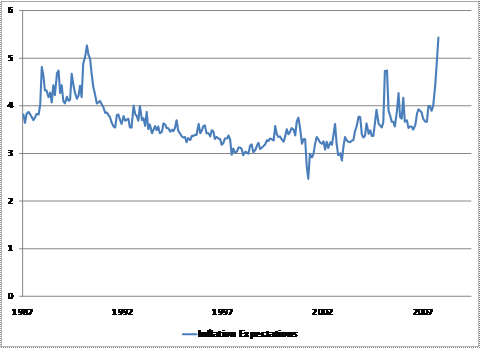
William Hester on the Hussman Funds web site with an excellent article on one half of the Red's rocck and a hard place. Include a chart and a couple of excerpts but the whole article is good.

If inflation expectations have taken the prominent
role in guiding future inflation, some difficult policy situations
could arise. It is generally expected that more slack in the labor
force should ease inflation. But Bernanke and Mishkin have argued that
inflation has become less responsive to the unemployment gap, while
inflation expectations have grown in importance. That means it may be
more difficult to lower inflation and inflation expectations once they
become elevated. If inflation is less responsive to labor slack, more
slack – that is, higher unemployment - will be needed to lower
inflation (the measure of this tradeoff is often referred to as the
sacrifice ratio).

This means that delaying
convincing actions that would show that the Fed can contain price
levels would require a more severe response further down the road. A
credibly tough monetary policy would be a more manageable task if the
economy was recovering from a recession, instead of what looks like the
early stages of a contraction. Add in credit markets where
counter-party fear still dominates, an unemployment rate still rising,
and a presidential race looming, and the Fed seems to be left with few
effective responses

Bernanke and crew are between credit collapse and rising inflation the solutions appear incompatible. I prefer they deal with the dollar for the following reason: a weak economy due to credit contraction and the collapse of housing speculation is a painful 2 or3 year problem, but loss of control of future inflation expectations is at least a decade long problem.
Do a sudden coorddinated dollar intervention, send the message that is no longer going down. Make it worth investing in US assets again. It may hurt the economy more in the short term, but think of it as the quick sharp pain of a bikini waxing instead of the drawn torture of tweezers one follicle at a time.

Friday, June 20, 2008

McCulley On Inflation


A Kind Word for Inflation

No, I have not lost my mind. I’m fully aware that inflation is not kind to bonds, so offering a kind word for inflation is de facto offering an unkind word about my own business. Investment managers don’t tend to do that. But facts are facts. And the essential fact right now is that the American economy needs an inflation rate above the Fed’s comfort zone. Needs, you ask?

Yes. Soaring commodity prices, particularly for petroleum and food, and especially in recent months, are an unambiguous negative real terms of trade shock to America. For those not familiar with the term, a nation’s terms of trade is the ratio of what it must give up to get what it imports. The easiest way to understand the concept, at least for me, is to think of the number of hours of work necessary, at the average national hourly pay rate, to buy a barrel of oil – a real variable compared to another real variable. The chart below (above here) tells that simple story.

Paul McCulley is an expert on the fed and always worth reading.

Monday, April 7, 2008

BCA: Fed Looks For Second Half Revival


The Bank Credit Analyst:
In Congressional testimony, Fed Chairman Bernanke spent most of his speech explaining what has happened in credit markets and why the Fed bailed out Bear Stearns. However, he also suggested that the worst for the economy is almost over.

Sunday, April 6, 2008

Rodriquez: On inflation

A letter from Robert Rodriquez the outstanding fund manager at FPA Advisors. This is one of the best investors in the country and he sees a new financial era upon us. I suggest you read this.
Crossing the Rubicon
We believe that one of these unintended consequences will likely lead to the Federal Reserve becoming even more politicized. With the taxpayer’s purse being placed at greater risk by these governmental entities’ increased financial risk, the process by which the Federal Reserve conducts monetary policy may be placed in jeopardy. Will the Fed be as willing to raise interest rates to fight economic excesses or inflation if it means it could cause losses for these governmental entities or place the American mortgage borrower at increased financial risk? Given the extreme measures that are currently being contemplated, we believe this is a serious risk consideration. If we are willing to “rescue” borrowers and financial institutions that have been reckless or unwise in their financial decision making leading up to this crisis, how can we expect a different outcome in the future? Why should individuals and financial institutions conduct themselves in a financially prudent manner, knowing that the government will likely ride to their rescue? Why shouldn’t they take increased risk with the expectation of short-term gain, while laying off long-term risk to the government? The Federal Reserve’s recent policy changes, federal agency enhanced risk taking and possibly new consumer mortgage “rescue” plans, all have the potential of increasing future unsound business and consumer decision making.

Tuesday, March 18, 2008

Fed Cuts Funds Rate to 2.25%


Fed Funds cut to 2.25% down 75 basis points.
Bespoke provides this nice chart of the fed funds rate going back to the 70's.


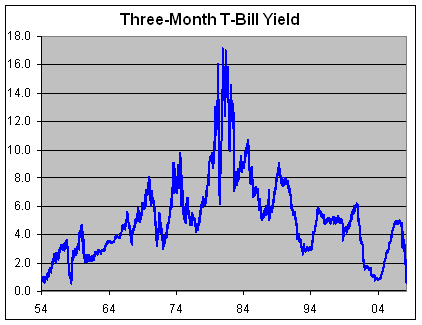
Update: Just found this T-Bill chart posted at CrossingWallStreet on Monday. The chart shows 3 month treasury bill yields at 50 year lows.

Saturday, March 8, 2008

MISH: Does Stability Breed Instability?


Mike Shedlock who has been terrific on the subprime and credit crisis has a great post with some good charts (including the one above) showing the disconnect between longer term treasury yields and mortgage yields. He asks the question "does stability breed instability?" I would answer not necessarily but stability with the Greenspan put does breed instability. Assuming the Fed is going to insure stability encourages excessive leverage and excessive leverage guarantees instability.

Levered players tend to favor "liquid markets" because the relative ease with which they can slip into and out of those markets makes the leverage seem safer because one can always get out. Every so often, and this is one of those times, the market reminds these people that liquidity is not a fixed constant but another variable. Liquidity is inversely correlated to crisis. To illustrate the point I remember being in the bond pits during the 1987 market crash. One day the bid ask spread in the bond price was one thirtysecond of a point wide ($31.25 between bid and offer on $100,000 of bonds) with thousands of contracts bid for and offered. The very next day the bid ask spread for the same contract was one full point wide ($1000.00) with one hundred contracts bid or offered if one was lucky. That occurred in one of the most liquid markets in the world. Liquidity happens when traffic is heavy in both directions when everyone heads the same way, not so much.

The unwinding of leverage in the credit markets has completely erased the normal liquidity in the credit markets by sidelining so many of the participants. Cutting the Fed Funds rate in this environment is like handing out two for one coupons for circumcision. There just aren't that many takers.

Bargains exist in credit securities right now but not many bargain hunters. The Fed and Treasury need to engineer a quick dollar intervention to shake out the short dollar speculators and send a message to potential overseas buyers of long term credit market instruments that the US government is not going run a continuing policy of benign neglect of the dollar. A few of them might just begin to look for bargains. The Fed cannot quickly cure the housing situation and it does not need to. Mr. Bernanke needs to concentrate on finding a way to put a bid in the credit markets.

Sunday, February 24, 2008

Brad Delong: 3 Cures For 3 Crises

In the Tapei Times Brad Delong writes a nice article describing the problems the Fed has in deciding what tactics are suitable for the credit problems they face.
The first -- and "easiest" -- mode is when investors refuse to buy at normal prices not because they know that economic fundamentals are suspect, but because they fear that others will panic, forcing everybody to sell at fire-sale prices.

______________

In the second mode, asset prices fall because investors recognize that they should never have been as high as they were, or that future productivity growth is likely to be lower and interest rates higher. Either way, current asset prices are no longer warranted.

This kind of crisis cannot be solved simply by ensuring that solvent borrowers can borrow, because the problem is that banks aren't solvent at prevailing interest rates. Banks are highly leveraged institutions with relatively small capital bases, so even a relatively small decline in the prices of assets that they or their borrowers hold can leave them unable to pay off depositors, no matter how long the liquidation process.

In this case, applying the Bagehot rule would be wrong.

The problem is not illiquidity but insolvency at prevailing interest rates. But if the central bank reduces interest rates and credibly commits to keeping them low in the future, asset prices will rise. Thus, low interest rates make the problem go away, while the Bagehot rule -- with its high lending rate for banks -- would make matters worse.

_________________

The third mode is like the second: A bursting bubble or bad news about future productivity or interest rates drives the fall in asset prices. But the fall is larger. Easing monetary policy won't solve this kind of crisis, because even moderately lower interest rates cannot boost asset prices enough to restore the financial system to solvency.

When this happens, governments have two options. First, they can simply nationalize the broken financial system and have the Treasury sort things out -- and reprivatize the functioning and solvent parts as rapidly as possible. Government is not the best form of organization of a financial system in the long term, and even in the short term it is not very good. It is merely the best organization available.

The second option is simply inflation. Yes, the financial system is insolvent, but it has nominal liabilities and either it or its borrowers have some real assets. Print enough money and boost the price level enough, and the insolvency problem goes away without the risks entailed by putting the government in the investment and commercial banking business.

Delong contends, correctly I believe, that the Fed initially believed they had a type one problem but now are operating on the assumption they face a type 2 crisis. If the Fed should decide they have a type 3 problem it will have distinct implications for where one should be invested.

I wonder if that is what gold is signaling. Remember the old Chinese curse "May you live in interesting times."

Tuesday, February 19, 2008

The Bear Market Case

I posted three somewhat bullish articles in a row so here is the other side.
Martin Wolf at the FT makes the bear case with the help of Nouriel Roubini. in this article:

America’s economy risks mother of all meltdowns

Recently, Professor Roubini’s scenarios have been dire enough to make the flesh creep. But his thinking deserves to be taken seriously. He first predicted a US recession in July 2006*. At that time, his view was extremely controversial. It is so no longer. Now he states that there is “a rising probability of a ‘catastrophic’ financial and economic outcome”**. The characteristics of this scenario are, he argues: “A vicious circle where a deep recession makes the financial losses more severe and where, in turn, large and growing financial losses and a financial meltdown make the recession even more severe.
The article goes on to spell out Professor Roubini's list of twelve steps to a very bad recession. I don't know if these things will happen (some have already) but they are all certainly possible. The most encouraging thing I can say is that people are talking about these risks now whereas a year ago such talk was dismissed out of hand.

PS. Mr Roubini has an interesting site here.

Saturday, February 16, 2008

Some Positive Reaction To Lower Rates

A little pop up in the number of applications for refinancing finally. One of the first signs that the Fed's actions are getting a response.

This chart off of the general forum at GaveKal

Aleph: Explains The Yield Curve"s Message

The Aleph Blog on the message of the yield curve. inteesting post.

So, what’s unusual about the current yield curve?

  1. The slope of six months to three months (19 bp) is very inverted — a first percentile phenomenon.
  2. The slope of two years to three months (38 bp) is very inverted — a third percentile phenomenon.
  3. The slope of seven years to ten years is steep (57 bp - 5 bp away from the record wide) — a 100th percentile phenomenon.
  4. The slope of five years to thirty years is steep (186 bp - 30 bp away from the record wide) — a 100th percentile phenomenon.
  5. The slope of two years to thirty years is steep (274 bp - 97 bp away from the record wide) — a 97th percentile phenomenon.
  6. The slope of ten years to thirty years is steep (82 bp - 29 bp away from the record wide) — a 98th percentile phenomenon.
  7. The butterfly of three months to two years to thirty years is at the record wide (312 bp). (Sum of #5 and #2. Buy 3 months and 30-years, and double sell 2-years? Lots of positive carry, but the 30-year yield could steepen further versus the rest of the curve, and its price volatility is much higher than the shorter bonds.)

What prior yield curves is the current yield curve shaped like?

  • 9/7/1993 — after the end of the 1990-1992 easing cycle to rescue the banks from their commercial real estate loans.
  • 2/15/1996 — after the end of a minor easing cycle, recovering from the 1994 “annus horribilis” for bonds.
  • 9/14/2001 — 60% through the massive easing cycle where Greenspan overshot Fed policy in an effort to reliquefy the economy, particularly industrial companies that were in trouble. Also days after 9/11, when the Fed promised whatever liquidity the market might need to stave off the crisis.

Okay, I’ve set the stage. What conclusions might we draw from the current shape of the yield curve?

Go to Aleph to read his conclusions. (I am only willing to pirate so much of his work)