Showing posts with label subprime. Show all posts

Tuesday, May 12, 2009

Tim Price nails situation in makets.

The Price of Everything
It’s not just what you know, it’s who you know. And it’s not just who you know, it’s who you pay off.
Click on the this to read it all.

Also for those people fighting the market uptrend, which is most of the professionals, "it is the stimulus stupid". As I have said again and again the huge stimluls put in by the Bush administration has been cyclcling through the system for almost 8 months and it is leakking steadily into the stock market. The stimulus has a much bigger and faster effect on the stock market than on the economy. The money has to go somewhere and some of it is going into equity investment. Some of a stimulus that large is a lot of money. Later on, 4 to 8 months from now the Obama stimulus is going to have its effect and we get a surge from that too. It is all artificial and will eventually go bad, very bad, when they initiate their huge tax increases on a tiny minority group and simultaneously try to shrink the Fed balance sheet. Better get your skates on for that one.

Friday, March 27, 2009

Stiglitz: Capitalist Fools

A good history of the financial crisis and its long term causes at Vanity Fair. This is the one I would start with:
No. 2: Tearing Down the Walls
The deregulation philosophy would pay unwelcome dividends for years to come. In
November 1999, Congress repealed the Glass-Steagall Act—the culmination of a
$300 million lobbying effort by the banking and financial-services industries, and
spearheaded in Congress by Senator Phil Gramm. Glass-Steagall had long separated
commercial banks (which lend money) and investment banks (which organize the sale
of bonds and equities); it had been enacted in the aftermath of the Great Depression
and was meant to curb the excesses of that era, including grave conflicts of interest.
For instance, without separation, if a company whose shares had been issued by an
investment bank, with its strong endorsement, got into trouble, wouldn’t its
commercial arm, if it had one, feel pressure to lend it money, perhaps unwisely? An
ensuing spiral of bad judgment is not hard to foresee. I had opposed repeal of Glass-
Steagall. The proponents said, in effect, Trust us: we will create Chinese walls to
make sure that the problems of the past do not recur. As an economist, I certainly
possessed a healthy degree of trust, trust in the power of economic incentives to bend
human behavior toward self- interest—toward short-term self- interest, at any rate,
rather than Tocqueville’s “self interest rightly understood.”
The most important consequence of the repeal of Glass-Steagall was indirect—it lay
in the way repeal changed an entire culture. Commercial banks are not supposed to be
high-risk ventures; they are supposed to manage other people’s money very
conservatively. It is with this understanding that the government agrees to pick up the
tab should they fail. Investment banks, on the other hand, have traditionally managed
rich people’s money—people who can take bigger risks in order to get bigger returns.
When repeal of Glass-Steagall brought investment and commercial banks together,
the investment-bank culture came out on top. There was a demand for the kind of high
returns that could be obtained only through high leverage and big risktaking.
Congress and the Clinton administration undue Glass-Steagall separating commercial from investment banks, a law specifically passed after the great depression to keep banks away from market related risks. Then Congress pushed the GSE home lenders to loosen credit standards and lend to poorly qualified borrowers. That of course is the same group of congressmen who are pointing fingers at bankers for doing what the Congress said they could. What a bunch of schmucks. None of this is to excuse the venality and lack of ethical standards among Wall Street executives.

Thanks to Fullemoney for pointing out this article.


Thursday, March 5, 2009

Barney (not so) Frank

Blarney is out strutting around with righteous indignation again today. Remember he was a huge backer of Fannie and Freddie leveraging up and lowering credit standards to potential borrowers. Oh and incidentally a big beneficiary of political donations from fannie and Freddie and the various overpaid politically appointed CEOs of those companies. VIDEO

Saturday, February 28, 2009

Liberal Media Censorship In Action

I was sent this message about video that was suppressed by threat of law suit by Time Warner at the behest of liberal media supporters of the Democrat party and supporters of the Obama campaign:

Object: The video clip that was not allowed in the USA - Pass this on to everyone.

This video shows that George Bush tried to warn Congress starting in 2001 that this economic crisis was coming, if something was not done. But congress refused to listen, along with Barney Frank. This video says it all.

The liberal AMERICAN media did not want this video on You Tube, so they had Time Warner threaten a law suit (proprietary rights) if it was not taken off.

This link is of the same video but is routed through Canada . Everyone in America needs to see this!

the video is linked through Canada because it has been blocked for the US by the very people should be the gaurdians of free speech.

Friday, October 24, 2008

Just the guy who won

Stolen from Fullermoney:

How the bailout works...

Young Chuck moved to Texas and bought a Donkey from a farmer for $100.
The farmer agreed to deliver the Donkey the next day.
The next day the farmer drove up and said, 'Sorry son, but I have some bad news, the donkey died.'
Chuck replied, 'Well, then just give me my money back.'
The farmer said, 'Can't do that. I went and spent it already.'
Chuck said, 'Ok, then, just bring me the dead donkey.'
The farmer asked, 'What ya gonna do with him?
Chuck said, 'I'm going to raffle him off.'
The farmer said, 'You can't raffle off a dead donkey!'
Chuck said, 'Sure I can Watch me. I just won't tell anybody he's dead.'
A month later, the farmer met up with Chuck and asked, 'What happened with that dead donkey?'
Chuck said, 'I raffled him off. I sold 500 tickets at two dollars a piece and made $998.'
The farmer said, 'Didn't anyone complain?'
Chuck said, 'Just the guy who won. So I gave him his two dollars back.'
Chuck now leads the US bank bailout team.


Wednesday, September 24, 2008

Overheard in Washington

"Son, we live in a world that has bonds and those bonds need to be bought by men with balance sheets. Who's gonna do it? You? You, Lieutenant Fuld?
I have a greater responsibility than you can possibly fathom. You weep for Bear Sterns and curse the short sellers; you have that luxury. You have the luxury of not knowing what I know: that Lehman's death, while tragic, probably saved firms and that my existence, while grotesque and incomprehensible to you, saves markets.
You don't want the truth because deep down in places you don't talk about at parties you want me buying bonds, you need me buying bonds. We use words like TSLF, PDLF, Super SIV. We use them as the backbone of a life trying to defend something. You use them as a punchline.
I have neither the time nor the inclination to explain myself to a man who rises and sleeps under the blanket of the very freedom I provide and then questions the manner in which I provide it. I would rather you just said "thank you," and went on your way. Otherwise, I suggest that you pick a sub-prime option arm bond and pay par.
Either way, I don't give a damn what you think you are entitled to."

(I do not know the author of this comment but I love it.)

Friday, July 25, 2008

New ways to Naked Short Sell

Mike Shedlock has a couple of good articles discussing Washinton Mutual and the apparent risk large depositors are taking when they have deposits in excess of FDIC insurance. In these articles Mish happens to mention a couple of ways to effectively place a short bet on stock without borrowing any.
First is
Unusual PUT Activity

My friend AJ alerted me of unusual PUT activity on Washington Mutual on Thursday.

AJ Writes: "Someone thinks WM is going under. 35,000 Aug. put contracts traded at the 3 strike today, and 12,000 Sept. PUT contracts at the same strike. Both dwarfed open interest, so they're mostly new positions. This reminds me of activity in Bear Stearns in March."

Here is a dynamic table of options on WaMu.


click on chart for sharper image

In case you are not familiar with the term, PUT buyers are betting on or protecting against share price declines. This is heavy activity at the strike discussed. The above table is from Thursday.
So one way to get short a stock is to buy puts. Also sell calls.

The second method for getting short;
Washington Mutual debt protection costs jump

Action in Credit Default Swaps (CDS) show a large as well as increasing chance of bankruptcy at WaMu. Reuters is reporting Washington Mutual debt protection costs jump .
Credit protection costs on Washington Mutual rose sharply on Friday, a day after an analyst said some creditors reduced their exposure to the largest U.S. savings and loan.

The cost of protecting [$10 million of] Washington Mutual's debt for five years rose to $1.85 million on an upfront basis, plus $500,000 in annual premiums, up from about $1.35 million plus $500,000 annually on Thursday, according to a trader.
Not Just WaMu

By the way, I am not just talking about WaMu here. Any bank whose share price is in the single digits is at extreme risk. Any bank whose share price is under $5 is at risk of imploding overnight.
The second article is here and continues the discussion from the first article.

Friday, July 4, 2008

Round-table Discussion: How to Prevent the Next Bubble

From Prieur du Plessis of
Investment Postcards From the Edge

“The financial crisis has shown that markets are bubble-prone and that laissez-faire regulation doesn’t work. The authorities need to get a grip if we are to avoid a mega-bubble. But we may need an even deeper crisis for that to happen.” That is the conclusion of a fascinating round-table discussion just published by Prospect magazine.

The participants (from top left to bottom right) were: Mark Hannam who spent 12 years working in the City for the Bank of England, Citibank and Barclays; Jonathan Ford (chair), deputy editor of Prospect; John Gieve, deputy governor for financial stability of the Bank of England; Martin Wolf, chief economics commentator at the Financial Times; Anatole Kaletsky, an economic commentator and associate editor of the Times; and George Soros, chairman of Soros Fund Management.

click here for full text of this interesting article.


Tuesday, June 17, 2008

Hussman:


Hussman Funds - Weekly Market Comment - Fed to Markets: "We Ain't Got To Show You No Stinking Credibility"


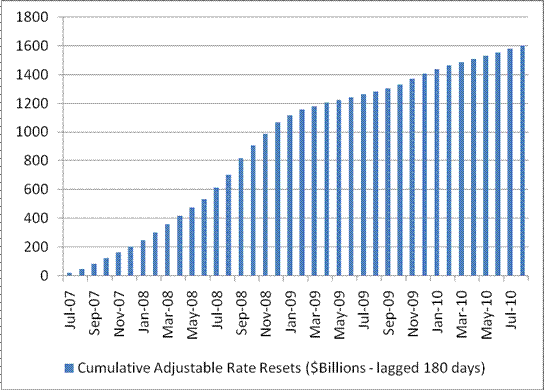
That fallout from the housing bubble is just beginning to hit its
stride in terms of mortgage delinquencies and foreclosures. As I noted
in my April 14 comment (Which “Inning” of the Mortgage Crisis Are We In?),
since the progression of foreclosures has mirrored the pattern of
adjustable mortgage rate resets, mid-2008 will most likely represent
the highest rate of change in cumulative foreclosures, after which they
will continue to rise but at a moderating rate.

Wednesday, May 21, 2008

Calculated Risk: Option Arm Training Video

From Calculated Risk:
Channel 5 in San Francisco got its hands on some "training videos" used by World Savings--now owned by Wachovia--to teach brokers and loan officers how to originate their "Pick-A-Payment" negative amortization ARM. It's pretty disgusting:
I agree.

Tuesday, May 20, 2008

U.S. Home Builders: No Light At The End Of The Tunnel


BCA: Sentiment among U.S. home builders remains at rock bottom levels - builders expect no improvement in sales over the next six months.

Wednesday, May 14, 2008

Tuesday, May 6, 2008

Troubled Bankers Choking Off More Borrowers

from Bloomberg:

May 6 (Bloomberg) -- Countrywide Financial Corp. has suspended the home equity credit lines of almost all its Las Vegas customers, including the $60,000 Christopher Whipple says he needed to expand his cell-phone accessories business.

``I hope this doesn't break me,'' the 35-year-old retailer said. His credit score was 790 out of a possible 850, putting him in the top 40 percent of borrowers.

Since January, Countrywide, Bank of America Corp., Washington Mutual Inc. and IndyMac Bancorp Inc. have frozen about 600,000 equity credit lines nationwide, said Michael Kratzer, president of a Bankrate Inc.-owned Web site that's fielding consumer complaints. The lenders are targeting borrowers in cities where property values are falling, including Las Vegas, Chicago and Los Angeles, he said.

Frozen credit and real estate declines are putting a chill on spending and hurting the economy. In February, taxable sales in Clark County, Nevada, which includes Las Vegas, fell 3.1 percent from a year earlier, dropping 13 percent at furniture stores and 6 percent for durable-goods wholesalers. In the same month, as it became harder to borrow money across the U.S., consumer spending rose at the slowest pace in more than a year.

The implications for the economy from these tighter lending standards is very negative. The swing from no credit standards to very stringent standards is the mechanism for spreading the housing crisis into the broader business economy. This is also why the very worst recessions tend to be drawn out double dippers and not V- shaped quick rebounders.

Tuesday, April 29, 2008

Case Schiller House Price Index Still Bleak


Chart from Calculated Risk :
We've discussed before the differences between Case-Shiller and OFHEO. Another important point is that the Fed uses the OFHEO series to calculate changes in household real estate worth in the Flow of Funds report. To the extent the OFHEO index missed the runup in prices in recent years, the Fed underestimated the increase in household wealth - and therefore probably underestimated the wealth effect on consumers.

Now that prices are falling, if Case-Shiller is a more accurate reflection of actual prices than OFHEO (as I believe), then the Fed might be underestimating the drag on consumer spending from falling prices.

Wednesday, April 23, 2008

Ambac; Perhaps We Misspoke


from Mish's Global Economic Trend Analysis and CNN:
Ambac originally projected that losses on the underlying collateral of the Bear Stearns transaction would be between 10% and 12%, but now expects losses at 81.8% of underlying collateral, a transaction that has seen an unexpectedly " rapid escalation of losses," and represents an outsized percentage of the insurer's expected credit impairment, Wallis said.

Tuesday, April 22, 2008

Barn Door Closing -- Horse Gone

From HousingWire:

Stick a Fork in It: Moody’s Downgrades 1,923 Subprime RMBS Classes — In Just Two Days


Moody’s Investors Service has decided that it’s finally time to downgrade investment grade subprime RMBS — you know, the Aaa-rated stuff? Between Monday and Tuesday, calculations by Housing Wire show that the rating agency has slashed ratings on 1,923 tranches from 232 separate subprime RMBS deals from 2005-2007 vintages.

That total includes hundreds of formerly Aaa-rated securities, as Moody’s embarked on its largest round of downgrades to investment grade subprime MBS since the credit crisis began.

A little over one month ago, HW covered a Bloomberg special report that suggested that both Standard and Poor’s and Moody’s were holding back on downgrades to the most senior RMBS bonds.

Hat tip to CalculatedRisk.

NYT: Triple A Failure

Roger Lowenstein has a terrific article in the New York Times ( All the news that's fit to slant) about the ratings agencies contribution to the credit crisis:
Triple A Failure

Sunday, April 6, 2008

Rodriquez: On inflation

A letter from Robert Rodriquez the outstanding fund manager at FPA Advisors. This is one of the best investors in the country and he sees a new financial era upon us. I suggest you read this.
Crossing the Rubicon
We believe that one of these unintended consequences will likely lead to the Federal Reserve becoming even more politicized. With the taxpayer’s purse being placed at greater risk by these governmental entities’ increased financial risk, the process by which the Federal Reserve conducts monetary policy may be placed in jeopardy. Will the Fed be as willing to raise interest rates to fight economic excesses or inflation if it means it could cause losses for these governmental entities or place the American mortgage borrower at increased financial risk? Given the extreme measures that are currently being contemplated, we believe this is a serious risk consideration. If we are willing to “rescue” borrowers and financial institutions that have been reckless or unwise in their financial decision making leading up to this crisis, how can we expect a different outcome in the future? Why should individuals and financial institutions conduct themselves in a financially prudent manner, knowing that the government will likely ride to their rescue? Why shouldn’t they take increased risk with the expectation of short-term gain, while laying off long-term risk to the government? The Federal Reserve’s recent policy changes, federal agency enhanced risk taking and possibly new consumer mortgage “rescue” plans, all have the potential of increasing future unsound business and consumer decision making.

Friday, April 4, 2008

The Bogus Uptick Argument


There have been dozens of articles lately blaming the market downturn on the removal of the uptick rule for short selling of stocks. i would list links but there are so many it is easier to just google the term uptick. Bespoke has an article today (the chart is from their site) and they appear to feel as I do that the argument is bogus.

First of all the market is still higher than when the uptick rule was removed. Second the market continued relentlessly higher for two years after the rule was removed. Third the big players in the market never had to worry about the rule anyway because they knew all the ways around it. All the rule really did was let the small guy go short without and uptick and they don't short much.

I have been a futures trader for over 20 years and we never had an uptick rule and guess which markets have been going highest lately-- futures market.

The problems in the market were caused by one thing. Leverage, actually excess leverage. hedge funds and prop desks used excessive leverage in what they believed was a safe market to take relatively small yields from a positive interest carry trade and turn those in to high returns. If you borrow 97 million dollars at 4% and lend 100 million dollars at 5% putting up just 3 million dollars from your fund you make a 33% yield on your money. Easy! Plus you charge your clients fees for providing this genius trading. Except that if the value of your loan backs up by only 3% all of your fund is wiped out.

That is what people were doing and they were doing it so much they flooded the mortgage companies with money to lend. Those companies responded by lending like crazy, no rigorous credit check, no down payment required, etc. Home buyers responded with enthusiasm and a positive feedback loop was off and running. The system worked great until it didn't work at all.

The leverage backfired the mortgage market and all those leveraged players blew up and the economy began to suffer from the now unavailable credit. The stock market did what it should do when the economy is going to recede, it began to go down.

Abuse of leverage is the culprit not the uptick rule. Blaming the uptick rule is just scapegoating by people who don't want to admit they failed to see this train wreck coming.

Update:
Daily Options Report commentary on Uptick
The Aleph Blog

Thursday, March 20, 2008

BCA: Fannie and Freddie Unbound


From Bank Credit Analyst:
The joint initiative announced by Fannie Mae, Freddie Mac, and their regulator, the OFHEO, should provide a strong boost to the mortgage market and allow prime MBS and other high-quality credit spreads to tighten.